

Garment District News | Costume Spotlight
The Lighthouse’s Salt, Wool, and Weathered Surface
In The Lighthouse, costume is not ornament. It is damp wool, sea salt, grime, rope, labor, and isolation — a tactile language of erosion that makes the body feel as battered as the landscape around it.
By Garment District News

The Lighthouse works because its clothing never feels “costumed.” It feels inhabited. The garments do not sit on the actors as historical illustration; they cling, drag, crease, and hang like pieces of a life defined by labor, cold, dampness, and repetition.
That physicality matters because this is a film obsessed with bodily endurance. The audience has to believe in the smell of the wool, the heaviness of the knitwear, the stiffness of wet outerwear, and the grime that accumulates through work and exposure. Costume becomes one of the film’s strongest ways of making the world feel closed in, exhausted, and hostile.
In a black-and-white film, fabric and finish become even more important. Without color doing the work, the costumes in The Lighthouse rely on texture, tonal contrast, silhouette, and surface damage. That makes the wardrobe especially compelling for anyone interested in how material reads on camera.
Linda Muir has explained that everything began with the script and long conversations with Robert Eggers about the backstory living between the lines. Because color could not carry character cues in the usual way, the burden shifted to texture, shape, fastening details, fiber weight, and the emotional behavior of cloth under harsh weather and hard labor.
The Designer Behind the Look

Image: Linda Muir, costume designer for The Lighthouse.
Linda Muir
Linda Muir designed the costumes for The Lighthouse, continuing her work of historically grounded, texture-driven costume design. Her approach helped make the film’s world feel materially convincing rather than theatrically “period.”
Her process was rooted in script analysis, historical research, and direct collaboration with Eggers. She tracked down manuals that specified button placement, found brass uniform buttons in multiple sizes for different coats, and built character through fine-grained textile decisions that never over-explained the story.
That is the achievement here: the clothing feels researched, but never museum-like. It is roughened by wear, shaped by occupation, and built to survive exposure. In a film defined by weather, madness, and ritualized labor, Muir’s costume work keeps the characters rooted in the body.
The Story Behind the Costume
Set in the late 19th century, The Lighthouse follows two men trapped in a remote maritime outpost, and the costume design has to support that confinement. There is no decorative excess here. Everything is reduced to function: hard-wearing workwear, maritime layers, knit caps, boots, heavy outer garments, and clothes that look repeatedly soaked, dried, and worn again.
That repetition is crucial. The costumes do not just reflect the period; they reflect routine. The men haul, scrub, carry, climb, and endure. Their garments need to read as tools as much as clothing. The more the film progresses, the more those tools seem fused to the body.
Muir has described one of the central challenges as creating authentic multiple looks for just two men with a minimum amount of clothing. The characters are supposedly on the island for only four weeks, and some of what they wear would have been issued work clothing rather than an expressive wardrobe. Yet those few garments still had to hold the audience’s interest across the full runtime and help drive the story visually.
The film’s visual language intensifies this effect. Shot in black and white and framed in a nearly square aspect ratio, The Lighthouse depends on surfaces that photograph with depth and severity. Coarse wool, weather-darkened outerwear, stained fabric, and stiffened edges become the equivalents of color drama. Texture is the spectacle.
This is where the wardrobe becomes unforgettable. The clothing looks as though it has absorbed the entire environment: salt air, kerosene, soot, moisture, mud, and fatigue. Nothing reads as fresh. Everything reads as handled. That is exactly why the film’s costume world feels so convincing.
For Garment District News, The Lighthouse is one of the best examples of costume as material atmosphere. The garments do not simply establish historical setting. They create a full sensory logic for the film — one where cloth, fiber, dampness, and wear help communicate power, routine, decay, and unraveling sanity.
“In The Lighthouse, texture becomes tension.”
Garment District News editorial takeaway.
Technical Breakdown
Textile
The costume language depends on rugged maritime materials: dense wool, coarse shirting, practical knitwear, hand-knit sweaters, heavy-duty work layers, bonded oilskin cloth, and protective outerwear that plausibly belongs to lighthouse labor rather than polished period display.
Color / Tonal Story
Because the film is shot in black and white, tonal value matters more than color itself. Costumes are built to produce contrast through texture, dampness, grime, knit density, and differing fabric weights rather than relying on hue.
Construction
The silhouettes are functional, masculine, and labor-specific: layered shirts, work trousers, union undergarments, knit caps, thick coats, hand-built oilskins, and garments shaped by maritime utility rather than elegance. Historical button placement, cuffs, pockets, and sleeve shapes were treated as critical character details.
Processing / Finish
The key finish is environmental wear: salt, dampness, grime, soot, repeated handling, and the stiffness that comes from garments living too long in harsh conditions. The oilskins were cut, sewn, fitted, hand-waxed, sun-set, and buffed to a hard waterproof finish.

Wake, Winslow, and the Labor of Character
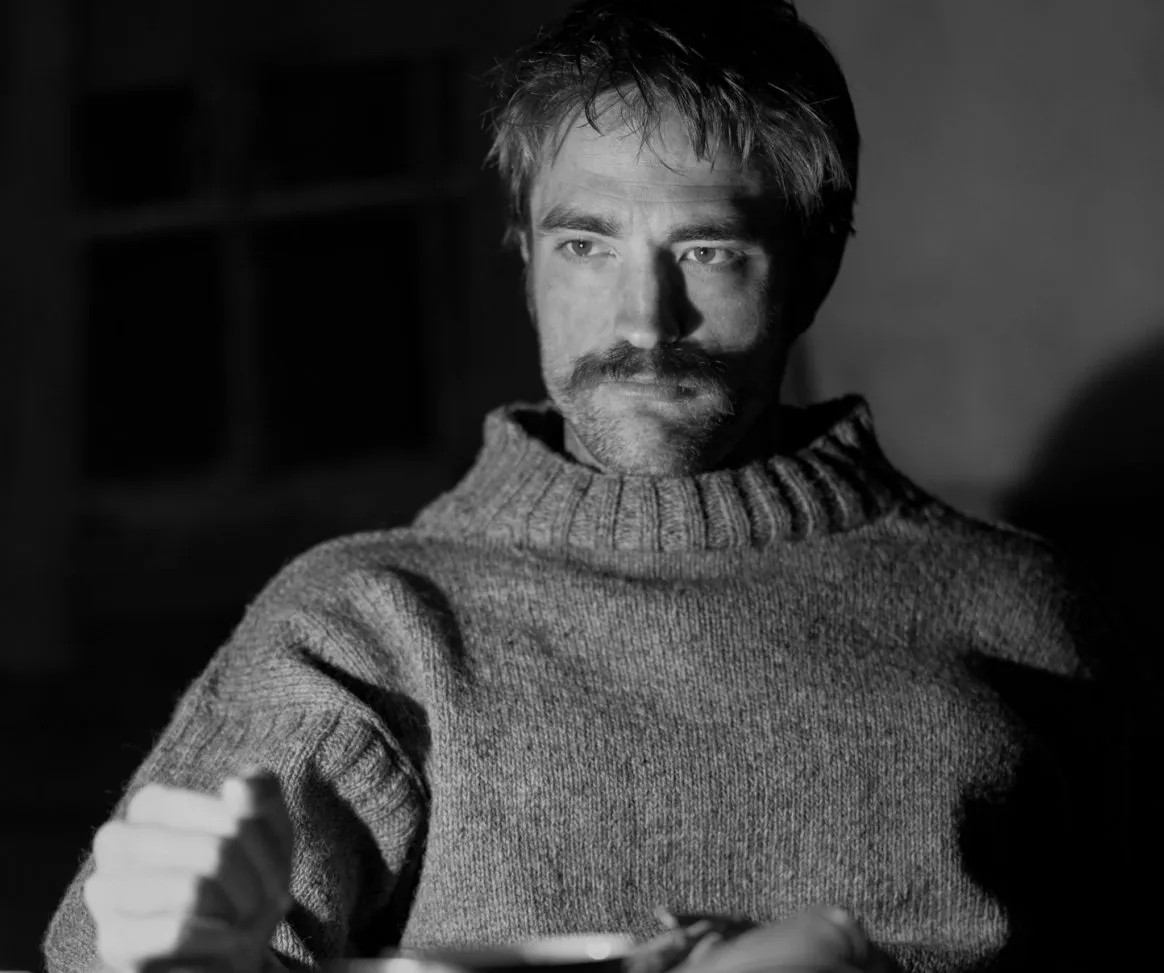
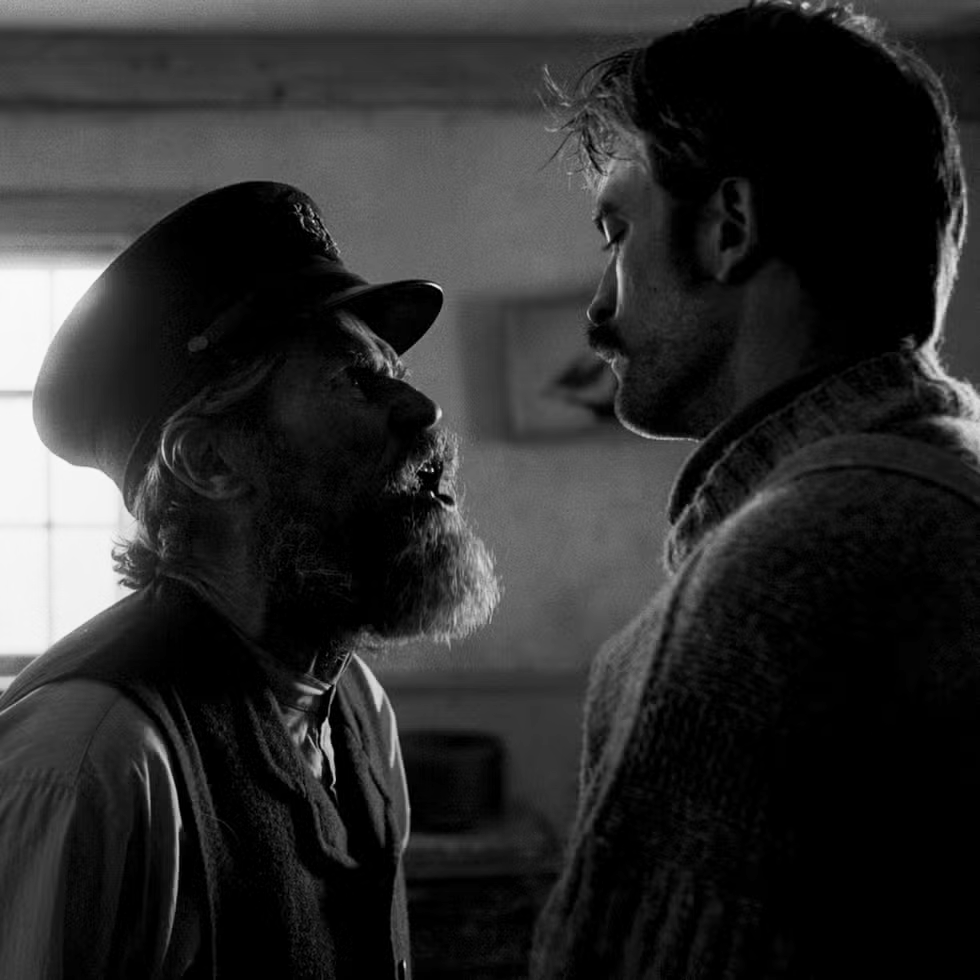
Muir approached Willem Dafoe’s Thomas Wake as a seasoned maritime figure whose clothing had to feel deeply evocative of seafaring life. His wardrobe carries the authority of experience: dense sweaters, weathered layers, and garments whose texture suggests years of salt, use, and ritual. The sweaters were hand-knit with stitches chosen to evoke nautical tradition, grounding Wake in a world of old labor and old superstition.
Robert Pattinson’s Winslow, by contrast, had to remain more ambiguous. He is more of a wanderer, a man with a less settled visual identity who has supposedly just come off logging work in Canada. Muir has spoken about the need to find a recurring coat for him that felt almost ironic in its repetition and psychological weight. That coat was recreated with a strange collar and a distinctive sleeve cap, proving how even odd pattern shapes and shoulder details can become part of a character’s inner instability.
This contrast between the men is also visible in their base layers. For interior scenes where Pattinson appears in a thinner shirt, the costume becomes more vulnerable and more revealing. Rather than reading as a modern shirt, it suggests a practical period underlayer — likely a lightweight plain-weave cotton or linen-cotton shirting with a matte finish, narrow seam work, simple placket construction, restrained cuffs, and fastening details that would sit quietly in the frame rather than call attention to themselves. In black and white, that subtlety matters. The difference between the lighter shirt and the denser wool outer layers helps build tonal depth, bodily fragility, and class-coded workwear realism.
Muir has also spoken about her insistence on period-correct sewing details, especially on garments that many productions would treat casually. Rather than finishing a one-piece men’s union suit with a modern overlock stitch, she studied an Edwardian example and recreated the pocket and cuff stitching so the garment would feel true to the era. That devotion to correct construction extended across the wardrobe, from buttons and trims to fabric sourcing. Even finding suitable plain weaves and woolens had become increasingly difficult because modern clothing no longer depends on the same material vocabulary.
Water, Weather, and Keeping the Costumes Working
One of the most revealing parts of Muir’s design story is how directly water shaped the costumes. She was on set every day, and the costume team’s job was not only to preserve the look but to keep the actors warm, dry, and able to perform. That practical responsibility explains why the oilskins were made so rigorously. They were not just period-inspired props; they were real working garments.
Because nothing suitable was readily available, the oilskin hats, coats, overalls, and boots were made for the production. Muir used two weights of oilskin cloth bonded together, then had the garments cut, sewn, and fitted before she and her team spent days hand-waxing them. They were then hung in the sun to set and polished with buffers into a hard finish. By the end, they were fully waterproof — effective enough that crew members kept asking where they had been sourced.
The rest of the wardrobe worked just as hard. The sweaters were genuinely warm. Layers of cotton and wool trapped heat. Heavy wool socks were sourced in Alberta, while some socks for the logger character came from Ireland. Battery-operated heated vests, blankets, cushions, and parkas all became part of the unseen support structure around the costumes. Even with all of that, there were scenes — including Willem Dafoe’s grave sequence in a pool of water — where comfort could only be managed so far.
This makes the costume achievement even more impressive. The garments had to survive driving rain, repeated takes, blood multiples, stunt use, dirt, exposure, and constant camera scrutiny. Most of the major costumes existed in triplicate for exactly that reason. In a production where the location was large, the weather relentless, and the actors on set nearly all the time, costume was never separate from endurance. It was one of the systems that made endurance possible.
Material and Cultural Context
Maritime clothing has always been shaped by necessity: protection from wind, wet, salt, labor strain, and cold. The Lighthouse channels that tradition, but filters it through a psychological horror lens. The result is workwear that feels both historically grounded and mythic.
This is also a rare example of a film where black-and-white cinematography pushes costume toward a deeper material intelligence. Without color seduction, the audience reads fiber, damage, weight, and shape more intensely. That turns clothing into atmosphere.
For Garment District News, The Lighthouse stands as a reminder that some of the most powerful costume design is not about complexity of decoration, but complexity of surface. A wet cuff, a salt-stiff collar, a darkened seam, a hand-knit sweater, or a matted union underlayer can tell the audience more than an elaborate embellishment ever could.
From Concept to Screen
The wardrobe had to make isolation, labor, and maritime severity feel immediate and bodily while giving two men enough visual variation to sustain the entire film.
Historical references, brass buttons, hand-knit stitches, bonded oilskins, and period-correct sewing details were shaped into garments that feel used, practical, and psychologically loaded.
Moisture, grime, wind, blood multiples, stunt use, and black-and-white photography made texture, warmth, waterproofing, and durability essential to the final image.
The film remains a benchmark for how costume texture, weathering, and restraint alone can carry mood, pressure, and historical credibility.
Gallery
Browse the image reference strip below and open each frame in a high-detail viewer to inspect costume distressing, texture, layering, material wear, and silhouette.
Why It Endures
The costumes in The Lighthouse endure because they understand that clothing can be psychological without ceasing to be practical. These garments never ask to be admired as standalone fashion objects. They ask to be read as evidence — of work, weather, age, fatigue, authority, humiliation, and unraveling control.
That is what makes them so powerful. They are materially persuasive at every scale. From across the frame, they establish class and labor. In close-up, they reveal fiber, moisture, grime, history, stitch choice, and surface treatment. The result is costume design that does not sit on top of the film’s atmosphere. It is the atmosphere.