

Garment District News | Costume Spotlight
Agatha All Along’s Film-Grade Dye, Witch Tailoring, and Symbolic Surface
In Agatha All Along, costume is not just character dressing. It is spell language, lineage, power, grief, theatricality, and transformation — a world built through tailored silhouette, symbolic embroidery, occult jewelry, controlled color, and film-grade surface design that lets every witch carry a different visual philosophy of magic.

The costume design in Agatha All Along succeeds because it understands that witches should not all look the same. Daniel Selon built a wardrobe system in which each member of the coven carries her own silhouette language, material weight, ornament logic, and emotional texture, allowing costume to function as personality, memory, and magical philosophy all at once.
What makes the work especially strong is that it refuses a lazy “witch costume” shorthand. Instead of flattening everyone into the same black-dress vocabulary, the series moves through sharp tailoring, old-world references, practical outerwear, forest textures, jewelry coding, and embroidered symbolism, making each witch read as an individual rather than a category.
For Garment District News, the real achievement is surface intelligence. These costumes are not impressive only because they are beautiful; they are impressive because they are built to communicate who these women are, what kind of magic they carry, how they move through the world, and how color, fabric finish, and hidden detailing become part of the story.
The Designer Behind the Look

Image: Daniel Selon, costume designer for Agatha All Along.
Daniel Selon
Marvel described Daniel Selon as the lead costume designer of Agatha All Along, responsible for dressing every witch in the series from Kathryn Hahn’s Agatha to Patti LuPone’s Lilia. In Marvel’s official interview, Selon explained that he and his team researched centuries of witch-inspired clothing and developed each character through specific references, symbolic details, and material logic rather than a single overarching witch uniform.
That research shows in the final wardrobe. The series does not merely costume a coven; it builds a layered visual grammar where coats, blouses, trims, embroidery, foil prints, metallic fabrics, amulets, and distressed surfaces all become part of the storytelling language. The workshop image of Selon with the mannequin reinforces that craft-led approach, showing construction, shaping, and fitting as part of the design process rather than an afterthought.
The Story Behind the Costume
Agatha All Along depends on costume in a very particular way: the clothes have to feel magical without slipping into costume-shop obviousness. Agatha, Alice, Lilia, Jennifer, the Green Witch, Death, Teen, and the Salem Seven all need distinct visual identities, but they also need to feel like they inhabit the same supernatural universe. The show solves that by treating costume as a set of parallel languages rather than one house style.
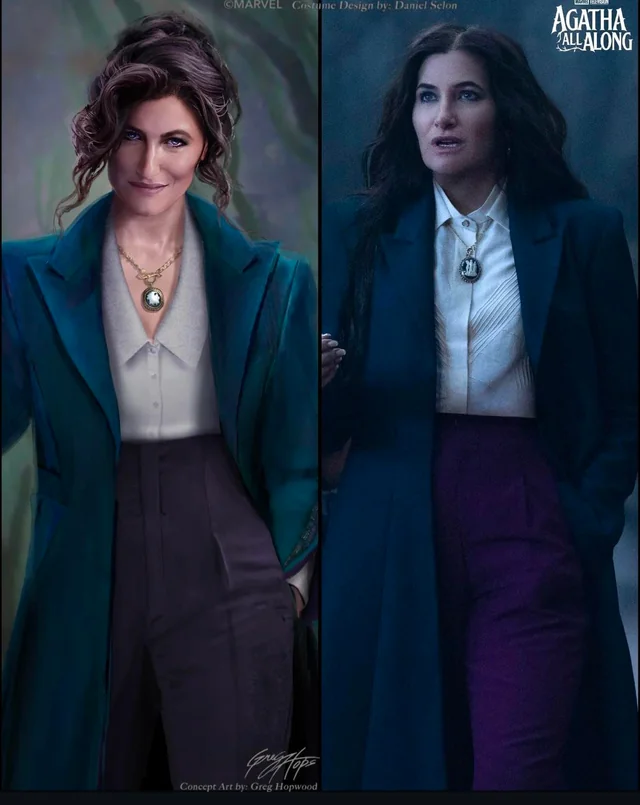
Agatha’s wardrobe is one of the clearest examples. Her long coat, sharp lapels, white shirt, purple trousers, cameo-like pendant, and tailored lines create a silhouette that feels both contemporary and old-soul. It borrows some of the authority of menswear tailoring, but then complicates it through jewel tones, coat movement, and the symbolic richness hidden inside the garment itself.
That hidden richness matters for a Fashion, Dye, and Film-Grade Dye discussion. Agatha’s coat is not simply dark on the outside and pretty on the inside; it is built around controlled color contrast. The outer teal-blue reads with cool authority and holds shape cleanly under low light, while the richer purple interior becomes a second, more secretive color story that emerges in motion, opening the garment into a piece of visual spellwork.
The interior embroidery and lining details push the design beyond a simple hero look and into narrative surface design. What appears at first glance to be a sleek outer garment opens into a saturated purple interior marked by pale runic or sigil-like motifs, turning the coat into a portable magical architecture rather than a mere statement piece.
This is where the show becomes especially compelling for GDN. The costume story is not just about silhouette; it is about interior logic. Linings matter. Embroidery matters. Jewelry matters. Distress, weave, sleeve proportion, shirt structure, foil, metallic sheen, and texture transitions all matter because they make the costumes feel inhabited rather than illustrated.
The wider coven works because each witch is allowed a specific material world. Teen’s costume language carries symbols and rune logic, Jennifer’s dress uses gold-foil potion motifs, Alice’s look leans into metallic fabric and hard protective detail, and Rio’s garments evoke bark, leaves, and living growth. In other words, dye, print, foil, metallic sheen, embroidery, and texture are not decorative extras in this series — they are how magic becomes visible.
“In Agatha All Along, every witch wears a different theory of magic.”
Garment District News editorial takeaway.
Technical Breakdown
Textile
The costume language moves between suiting wool, blouse cottons, textured jackets, draped skirts, embroidered linings, metallic fabrics, and specialty fantasy-finish materials. Even when a look reads as contemporary, the fabric choices keep it from feeling generic by adding weight, tactile interest, and character-specific identity.
Dye / Color Story
Color in Agatha All Along is not incidental. Agatha’s teal-blue coat exterior and saturated purple interior create a two-stage visual language of command and hidden power, while the rest of the coven is separated through their own palette systems — Jennifer’s polished tones and gold symbols, Rio’s bark-and-leaf greens and browns, Alice’s steely darks and metallics, and Lilia’s memory-rich folkloric coloration. In a film-grade dye conversation, what matters is how these hues are chosen to hold shape, symbolism, and legibility under low light, atmospheric lighting, and movement.
Construction
Construction is one of the series’ smartest tools. Coats are cut for authority and motion, jackets and vests define character function, collars sharpen hierarchy, and layered garments allow each witch to feel assembled from a personal history rather than a costume rack. Agatha’s coat in particular works because it carries the grammar of tailoring while still behaving like a supernatural statement piece.
Processing / Finish
Surface finish is where the work deepens: embroidery, printed runes, gold-foil symbols, metallic sheen, forest-texture fabrication, distressed wear, and occult jewelry all give the costumes an interior life. These garments do not simply dress the actors; they imply spell systems, memory, damage, history, and magical specialization through the way the surface has been dyed, printed, stitched, foiled, or worn.


Material and Cultural Context
Marvel’s official coverage makes clear that Selon approached the series through broad witch-history research rather than a single period or one-note reference set. That gave the show room to move between folklore, modern fashion, occult iconography, historical memory, and character psychology without collapsing into one easy category.
That flexibility is what makes the costume world feel contemporary and timeless at once. Some witches feel grounded in everyday clothing altered by magic, while others feel more overtly ceremonial, ecological, gothic, or mythic. The important thing is that each look feels authored — and that authorship often lives in the surface treatments, where color, foil, embroidery, printed symbols, and distressed texture carry more narrative than a simple silhouette ever could.
For Garment District News, Agatha All Along is a strong case study in how costume can make ensemble fantasy feel specific. The show proves that witches do not all need the same hat, the same black dress, or the same silhouette; they need a coherent inner logic, and this series gives each one that logic through textile, color, and finish as much as through cut.
From Concept to Screen
The wardrobe had to distinguish each witch visually while keeping the coven inside one believable magical universe.
Research into centuries of witch-inspired clothing gave the series a broader vocabulary than a single period style or cliché could provide.
Printed runes, embroidery, gold foil, metallic fabric, bark-and-leaf textures, and color-contrast lining work turned the costumes into narrative objects rather than simple outfits.
The series stands out because it treats witch costume as character design, emotional code, and visible magic all at once.
Gallery
Browse the reference strip below and open each image in the high-detail viewer to inspect tailoring, embroidery, distress, symbolism, jewelry, dye depth, foil finish, and witch-specific surface design.
Why It Endures
The costumes in Agatha All Along endure because they understand that fantasy wardrobe works best when it feels psychologically specific. These looks do not flatten magic into a house style; they let each character wear a different relationship to power, secrecy, history, and self-presentation.
That is what gives the wardrobe its staying power. The coats, jackets, vests, linings, jewelry, embroidery, foil, and textures all carry more information than the viewer first notices, which is why the designs keep rewarding a closer look. In a crowded fantasy landscape, that level of costume authorship is rare.