

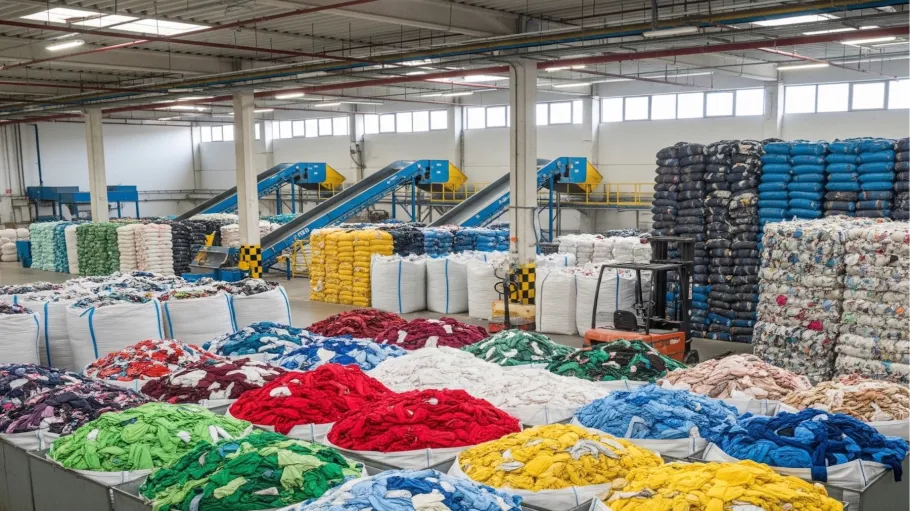
Government has pushed textile recycling into law. Now the fashion industry has to design, source, and buy as if circularity is no longer optional.
For years, textile recycling has been treated as an inspiring idea that sat just outside the real business of fashion. It belonged to sustainability panels, pilot programs, capsule collections, and annual reports. Brands praised it. Consumers were encouraged to believe in it. Recyclers were asked to prove it.
Now the political landscape has changed.
Across the European Union, governments are no longer waiting for fashion to voluntarily solve its waste problem. The EU’s revised Waste Framework Directive entered into force on October 16, 2025, with a targeted focus on food and textile waste. The rules build on the requirement that EU member states separately collect textile waste and introduce a harmonized framework for extended producer responsibility, making textile producers financially responsible for the collection, sorting, reuse, and recycling of the products they place on the market.
That is the quiet revolution now taking shape. Textile waste is no longer just a municipal problem or a consumer guilt problem. It is becoming a producer responsibility problem.
And that changes everything.
The recycling infrastructure is no longer the fringe story
Textile recyclers have spent years trying to build a market before the market was ready. They invested in sorting, fiber recovery, mechanical recycling, chemical recycling, resale partnerships, take-back programs, and material innovation while many brands continued to operate on a linear model: produce, sell, discount, discard, repeat.
The result has been a painful mismatch. Recyclers need steady material streams, cleaner input, better labeling, and predictable buyers for recycled output. Fashion brands need materials that meet quality, price, color, performance, and volume expectations. Between those two needs sits the hardest part of circularity: not the press release, but the purchase order.
Government policy is now forcing the gap into the open.
From January 1, 2025, EU member states were required to establish separate collection systems for textiles, meaning used textiles must be handled apart from general waste streams. The 2025 revision of the Waste Framework Directive then moved the system further by requiring national textile EPR schemes, producer registers, and rules that support collection, sorting, reuse, and recycling.
In plain terms: more textile waste will be collected, more producers will have to pay into the system, and more brands will be asked to prove what happens after their products leave the sales floor.
That is good news for recyclers — but only if fashion becomes a real customer.
The law can collect the waste. It cannot create taste.
The uncomfortable truth is that regulation can push textiles into collection bins, sorting facilities, and recycling channels, but it cannot automatically make recycled materials desirable. That job belongs to fashion.
Fashion has always known how to turn material constraint into aesthetic language. Wartime rationing shaped silhouettes. Denim became cultural mythology through wear and repair. Deadstock became desirable when designers framed scarcity as exclusivity. Vintage became luxury when curators, stylists, and brands taught consumers how to read age as value.
The same thing now has to happen with recycled textiles.
A recycled fiber cannot survive on morality alone. It has to become beautiful. It has to become useful. It has to become specifiable. It has to become something designers want to work with and buyers want to wear.
Government is pushing textile recycling. Now fashion has to dress it.
Circularity cannot be an afterthought at the end of the garment’s life
The biggest mistake brands can make is treating recycling as something that begins after a garment is unwanted. By then, many design decisions have already made recycling difficult or impossible.
A jacket made with blended fibers, heavy coatings, glued components, metallic trims, synthetic interlinings, laminated layers, and unclear labeling may be commercially attractive at retail, but difficult to disassemble or recycle at scale. A garment designed without regard for its end-of-life pathway becomes a problem passed down the chain.
The EU’s broader textile strategy points in the opposite direction. Its stated vision is that, by 2030, textiles placed on the EU market should be durable, repairable, recyclable, largely made of recycled fibers, free from hazardous substances, and produced with respect for social and environmental standards.
That means the future of textile recycling is not only about recycling plants. It is about design rooms, sourcing teams, mills, dye houses, trim suppliers, pattern makers, product developers, and merchandisers.
Circularity starts at the sketch.
The next customer is not the consumer. It is the brand.
Consumers are often blamed for textile waste, but consumers do not choose fiber blends at the development table. They do not decide whether a dress is made from mono-material fabric or a difficult-to-recycle blend. They do not select the coating, the adhesive, the lining, the finish, the trim package, or the hangtag language.
Brands do.
That is why extended producer responsibility matters. It shifts the cost of textile waste closer to the companies that design, produce, import, and sell the goods. Under the EU’s new rules, producers selling textiles into the EU will be expected to contribute to the cost of collection, sorting, and treatment of textile waste.
This is where fashion’s purchasing power becomes the deciding factor.
If brands continue to treat recycled materials as niche, experimental, or reputational, textile recyclers will remain underused. But if brands begin designing collections around recyclable inputs, recycled fibers, take-back partnerships, and clearer end-of-life pathways, recyclers become part of the supply chain instead of the cleanup crew.
The industry does not simply need recyclers to survive. It needs brands to buy from them, design for them, and build product calendars that give them predictable demand.
Unsold goods are also coming under pressure
The EU is not only targeting post-consumer waste. It is also moving against the destruction of unsold clothing and footwear. Under the Ecodesign for Sustainable Products Regulation, the ban on destroying unsold apparel, clothing accessories, and footwear will apply to large companies from July 19, 2026, with medium-sized companies expected to follow in 2030.
That matters because overproduction has long been one of fashion’s most hidden waste engines.
When unsold inventory can no longer be quietly destroyed, brands will need better forecasting, better resale channels, better donation systems, better recycling partnerships, and better product design. Waste will have to be accounted for not only after the consumer is finished with a garment, but before the garment ever reaches a closet.
This is where textile recyclers could become essential infrastructure — not as a last resort, but as part of a planned inventory and materials strategy.
The recycler’s problem is now fashion’s opportunity
For textile recyclers, the challenge has never been only technical. It has also been commercial.
They need consistent feedstock. They need garments that can be sorted efficiently. They need fiber compositions that can be processed. They need buyers willing to accept recycled output not as a compromise, but as a material category with its own value, performance standards, and design possibilities.
For fashion, this is an opportunity to rethink what luxury, performance, and responsibility look like in the next decade.
A recycled textile does not have to look apologetic. It does not have to be beige, plain, or burdened with moral messaging. It can be theatrical, technical, refined, rugged, delicate, industrial, romantic, or sharply tailored. The question is whether designers and brands are willing to move recycled materials out of the sustainability department and into the creative center of the business.
Because circularity will not become real when a government mandates collection.
It becomes real when a designer chooses the material, a buyer backs the order, a brand commits to volume, and a customer sees the garment as desirable.
Fashion asked for circularity. Now it has to participate.
The policy direction is clear. Textile waste is being separated. Producers are being made responsible. Unsold goods are being scrutinized. Reuse, repair, recycling, and recycled content are moving from voluntary ambition toward regulatory expectation.
But laws can only build the pressure. They cannot build the wardrobe.
That responsibility belongs to fashion.
The industry has spent years saying it wants circularity. Textile recyclers have spent years trying to make it possible. Government has now stepped in to push the system forward.
The next move is no longer theoretical.
Fashion has to dress the future it keeps promising.