
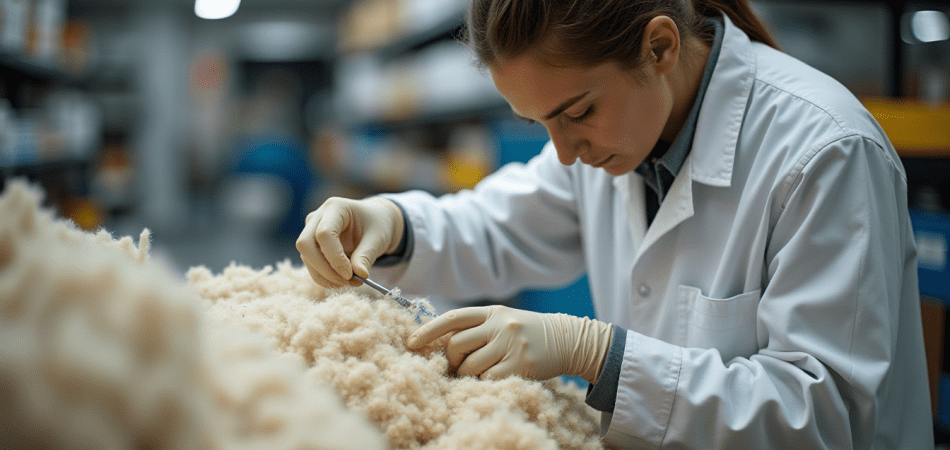
 When raw wool leaves the farm, before it is taken to market, it undergoes a testing procedure to ascertain its quality. Buyers and sellers throughout the wool supply chain need a reliable certification standard to inform their purchases and processes. The International Wool Textile Organisation (IWTO) provides this gold standard. IWTO certificates are trusted by wool supply chain stakeholders around the world. But what do these certificates actually mean, and what does our testing measure?
The Testing Behind the IWTO Certificate
When a wool bale reaches the market, it is expected to have a pre-sale certificate listing the results of a variety of tests. This certificate stays with the sale lot up until the processing stage.
These tests are performed to confirm the wool’s quality and characteristics. Specifically, these include:
- Fibre diameter. Often the most important, price-determining factor, fibre diameter is measured in microns. The certificate will state the average width of the wool fibres in each sample. Finer micron values mean softer and often higher-priced wool – although all wools have their uses, and it is important to confirm the right wool is used in the desired application.
- Clean yield: This represents what percentage of the bale consists of clean, dry, usable wool fibre after dirt, grease, sweat and vegetable material has been removed.
- Vegetable matter: A measure of the amount of contaminants such as grass, seeds, or twigs are found in the bale.
- Staple length and strength: Staple length tells the buyer about processing performance and spinning. For example. Shorter fibres are selected for woollen processing, while longer ones are better for worsted fibre.
- Colour: The closer a bale of colour is to pure white, the more valuable it is. This is because it can be dyed into a wider range of colours. Any discolouration thus devalues the wool.
- Contamination and purity: The wool must be free from contaminants such as baling twine, or any non-wool material.
Read Next: 5 Surprising Places You’ll Find Wool in 2026
The IWTO Certificate
After testing samples from each bale, IWTO testers issue a certificate stating the results for each of the above criteria, as well as some others, such as comfort factor and fibre curvature.
These certificates are widely recognised as the gold standard in the industry.
The IWTO measures and records these criteria according to a strictly maintained, and frequently reviewed, and updated set of specifications and methods. These are contained in the IWTO Red Book. These provide the technical and scientific measurements used in the compilation of IWTO test certificates.
The IWTO White Book contains the sampling and certification procedures, as well as the guidelines for resolving disputes over test results. You can learn more about these publications on our Testing Resources page.
Learn More About the World’s Wool
For more information on the wool industry around the world, take a look at our fact sheets, statistics and guidelines.
Now Read: IWTO Welcomes ZDHC Foundation
The post Behind the IWTO Certificate: How Wool Testing Ensures Quality from Farm to Fashion appeared first on International Wool Textile Organisation.