
 Wool goes through a long supply chain on its way to becoming a textile. The journey of a wool bale is a fascinating one, and the International Wool Textile Organisation (IWTO) works with stakeholders at every stage of the journey. Here is a short, step-by-step guide to this fascinating process.
The Long Journey from Fleece to Fabric
The wool supply chain typically involves eight stages: shearing, testing, sale, processing, spinning, weaving, knitting and dyeing. Let’s see what happens at each step.

1. Shearing
Our journey starts when the raw wool is shorn from the sheep. Depending on the farmer, climate conditions and other factors, shearing takes place once, twice, or even three times a year.
Shearing specialists remove the main fleece from the sheep’s body in one large piece. Shearing is like a haircut, and is done by specialists in a managed way so that stress to the sheep is minimized.
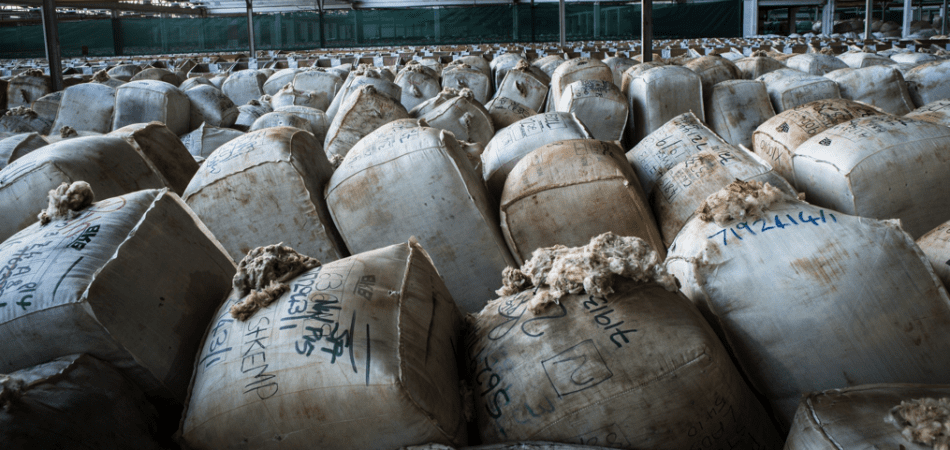
The fresh wool is sorted into classes. The main categories are fleeces, double cuts, pieces, bellies and locks. The classed wool is then grouped together into bags and these are compressed to make bales.
The sealed bales are marked with a label showing the names of the woolgrower and classer, as well as the type and class of the wool inside. Now it is time for the bales to leave the farm.
2. Testing
The warehouse is the first stop on the way to market. At the warehouse, the wool bales are grouped into sale lots of similar types and classes. Samples are taken from each bale and tested for fibre diameter, vegetable matter content, staple length, and colour.
Based on these tests, each bale is issued with a pre-sale certificate. This certificate remains with the sale lot all the way through to the processing stage.
Read Next: 5 Surprising Places You’ll Find Wool in 2026
3. Sale
Once the tests have been done, and it is understood what kind of wool and what quality is involved, most wool is then sold by auction.
During the season, in most wool growing countries, auctions take place once a week. Wool is a commodity and prices shift based on demand, supply volume, and quality levels.
4. Woollen and Worsted Processing
The individuals or organisations who buy the bales of wool are usually involved in the production and sale of woollen yarns. Once they buy the raw wool at auction, they begin producing yarn, using one of two possible processes: woollen and worsted.
Woollen yarn is made from shorter wool fibres. The wool is scoured, carbonised, carded and spun.
Worsted yarns are finely spun varieties made from long staple fibres. The process involves combing, which entails the removal of short fibres which are sent back into the system for recycling.
5. Spinning
Once the woollen and worsted wools are carded, the results are sent for spinning. The two processes involve distinct spinning methods, each producing yarn with distinct, easily identifiable characteristics.
Worsted yarns are spun with a tight, consistent twist, making them strong and sleek in appearance.
Woollen yarns are spun with a looser twist, resulting in a more “open” yarn with a fluffier texture.
6. Weaving
As we get closer to the end product, the processes become more specific.
In the case of woven fabrics, the wool yarns are put onto looms for weaving. Different qualities of wool are spun into different qualities of yarn, which in turn, are woven into distinct kinds of fabric.
Worsted-spun yarns are usually transformed into fine, tightly-woven fabrics such as those used in the making of suits, trousers and skirts.
Woollen spun woven fabrics are thicker and heavier, used mostly for sweaters, gloves, scarves, etc.
Wool textiles for interiors or other places may also be woven, such as blankets, throws, cushions, and upholstery.
7. Knitting
Not all wool is woven into fabric. It can also be knitted. There are many kinds of knitting machines. Today you may even see circular knitting that can knit without making a seam.
Knitted wool maybe become clothing items of various patterns and textures, as well as blankets and other décor items.
8. Dyeing
Dyeing, the process of adding colour to fibres and fabrics, can take place at several different points during the process. Wool can be dyed at the fibre, yarn, fabric, or garment stage.
Delivery to You
As you can see, there are many steps to creating a wool product. These steps are given as an overview: we didn’t even touch on wool carpets, acoustical panels, and much more!
The uses for wool are so many because wool is incredibly versatile. This versatility relates to sheep’s ability to adapt to different habitats around the world.
Learn More About the World’s Wool
For more information on the wool industry around the world, take a look at our fact sheets, statistics and guidelines.
Now Read: IWTO Welcomes ZDHC Foundation
The post Journey of a Wool Bale appeared first on International Wool Textile Organisation.