

Peatland Restoration and Wool: A Natural Partnership for Sustainable Landscapes
Peatlands form a vital part of the UK’s natural landscape. However, like so many natural places, peatlands are being severely damaged due to drainage, overgrazing, peat extraction, and human activities. Thankfully, this damage can be reversed. Read on to discover how wool is a key element of this important restoration initiative.

Why Do Peatlands Need Help?
Peatlands are among the world’s most effective carbon sinks and natural water regulators. Peatlands are small but mighty: they cover only 3% of the Earth’s surface, but hold about 30% of the world’s soil carbon. Home to a variety of rare plants, insects, and birdlife, peatlands also reduce flooding by absorbing and slowly releasing water.
Yet 80 percent of the UK’s peatlands are under serious threat. Modern development and climate change take a toll on these rich ecosystems. As they degrade, these vital carbon sinks release their carbon stores into the atmosphere.
Because that release accelerates global warming, environmentalists have begun to preserve and restore peatlands. This vital work depends on three key elements: water retention, soil structure, and erosion control.
Read Next: Wool at the Milano Cortina 2026 Winter Olympics
Enter British Wool
 Agriculture and forestry, among other activities, drain peatlands of their moisture. Restoration starts with rewetting the land. Rewetting is done by blocking ditches and raising the water table. At the same time, soil structure must be restored, to encourage the return of plant life. Peatland restoration projects therefore focus on stabilising eroded areas.
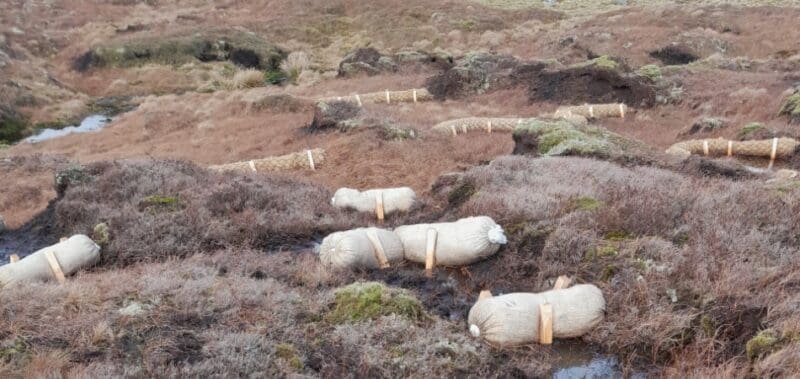
The central tools employed in these projects are large fabric logs or tubes, known as peatland restoration rolls. These are strategically placed in peatlands, where they faciliate
- water retention and rewetting,
- erosion control,
- land stabilisation,
- and encourage new vegetation growth.
Various materials have been used to make these logs, but wool is by far the most effective.
Wool as a Restorative Material
Due to the high absorbency of wool, wool logs boost peatland water retention. Acting as barriers, the wool logs prevent peat from being washed away, and promote the growth of sphagnum moss, an essential ingredient in the production of peat. In this way, the natural contours of the land can be restored, and the effects of erosion can be arrested and reversed.
Eventually, these fully biodegradable wool logs start to decompose, breaking down into the surrounding soil and enriching it with nutrients that can aid the growth of native plants.
The wool used for peatlands restoration is professionally scoured to the highest standards to ensure suitability for use in these sensitive habitats. Made by Wool Insulation Wales, using traceable Welsh wool and a Defra-approved process, wool logs have been placed in some of the UK’s most degraded peatlands.
Installed at various depths and positions, these simple-looking bundles are making a significant contribution to the restoration and reclamation of the UK’s peatlands.
About Wool Insulation Wales
Wool Insulation Wales offers Welsh wool peatland logs made to order. Founded in 2022 by Ruth-Marie Mackrodt and Mair Jones (who also happens to be a multi-generational sheep farmer). This duo team have a combined experience exceeding five decades in construction and housing.
Learn more about their flagship product, Truewool® Thermal Loft Insulation Rolls, at woolinsulationwales.com.
Now Read: Wool is Not Waste: Why the EU Needs to Reclassify Raw Wool
Image credits: Feature Photo of Welsh sheep by Manuel T on Unsplash. Wool peatland logs curtesy of woolinsulationwales.com.
The post Peatland Restoration and Wool: A Natural Partnership for Sustainable Landscapes appeared first on International Wool Textile Organisation.