
2026–27
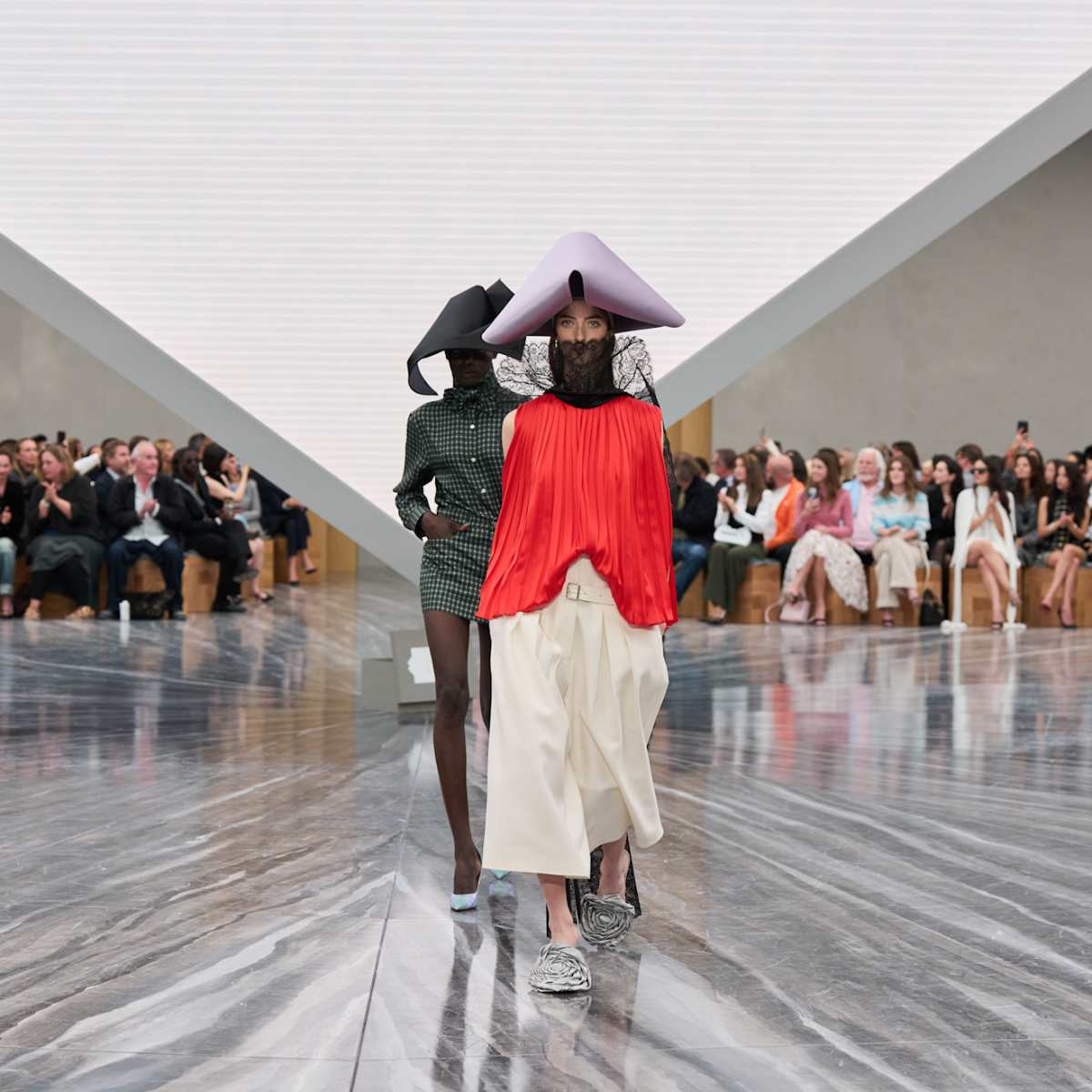
Paris Fashion Week this season arrived with something different in the air — confidence. Not the anxious posturing of a city defending its throne, but the deep, settled clarity of an institution that knows exactly where it stands.
From March 3 to 10, 2026, sixty-seven ready-to-wear shows packed the French capital’s most storied venues — from the lily-pad ponds of the Jardin des Tuileries to a glass residence overlooking the Eiffel Tower at nightfall. The week featured no shortage of fresh names and radical gestures, but the story that dominated was one of continuity and deepening: the designers who upended fashion’s establishment last season with their debuts were back with their sophomore collections, and — almost without exception — they delivered.
Jonathan Anderson at Dior. Matthieu Blazy at Chanel. Pierpaolo Piccioli at Balenciaga. Jack McCollough and Lazaro Hernandez at Loewe. The changing of the guard that sent shockwaves through the industry last autumn has locked into place. This is the new normal, and the new normal turns out to be extraordinary. And threading through all of it — from the grandest maison to the most unexpected debut — was a single thread that connected the century-old houses with one ten-year-old designer from West Los Angeles who made history on the very first day of the week.
The Week
Unfolded
The Collections
Everyone’s Talking About
Jonathan Anderson opened the week in bright spring sunshine at the Jardin des Tuileries, staging his second womenswear collection for Dior around a pond scattered with lily pads — an artificial water garden conjured just beyond sight of the Musée de l’Orangerie, home to Monet’s real Water Lilies. The resonance was deliberate. Anderson’s Dior is a house in conversation with art history, with nature as metaphor, and with the idea of whimsy as a serious design language.
The collection itself was widely considered his most complete showing yet — cinched waists and feminine tailoring given a uniquely Anderson playfulness. Voluminous tutus opened the proceedings, followed by classic checks, peplum jackets, fluid denim, and sculptural outerwear. Flora and fauna appeared everywhere: chrysanthemums on necklines and handbags, water lily jewellery and shoes, and — destined to go viral — a green suede bag in the shape of a turtle, with buttons for eyes. Front row: Alexa Chung, Anya Taylor-Joy, Jisoo, Willow Smith, and Priyanka Chopra.
Staged in a glass-walled residence with the Eiffel Tower shimmering behind, Vaccarello’s collection was nocturnal and immaculate. Eight slouchy, sharply tailored dark suits opened and closed the show, bookending a collection that unravelled between them into sheer lace coated in silicone (giving it an unexpected structural sheen), plush furs, and leather in burnt orange, tobacco, and black. Bella Hadid walked. Kate Moss, Michelle Pfeiffer, Zoë Kravitz, and Blackpink’s Rosé watched from the front row. A return to Le Smoking, the house’s most radical historical gesture — the tuxedo that redefined women’s tailoring in 1966 — anchored the entire collection.
If one collection drew the sharpest line between this season and the quiet luxury era that preceded it, it was Chloé. Kamali’s collection was giving Little House on the Prairie in the best possible way: peasant dresses, frou-frou skirts, ruffled hems, checked capes, and ditsy florals in cascading abundance. Fashion’s pared-back, minimalism-obsessed days are officially over — at least in the world of Chloé. Tartan and gingham appeared throughout, and the Bohemian femininity that defines the house came through in its most unrestrained form in years.
The former Proenza Schouler designers’ second Loewe collection confirmed that their architectural, beach-heat vision is the real deal. Leather molded like wetsuits, sheaths draped like towels, 3D-printed trompe l’œil terry frocks, and a striped polo mini with sun-bleached swagger. Roomy bags, rubber shoes with swap-in liners, and a shaggy orange coat paired with a tiny oyster bag. The color-led optimism — anchored by a show set fronted by Ellsworth Kelly’s 1989 Yellow Panel with Red Curve — felt joyful, precise, and genuinely new for the house.
Piccioli’s sophomore collection for Balenciaga went deeper and darker than his debut. Where his first show traded on the emotional clarity of a new beginning, this one was more complex — skinny tailoring worn with languid 1970s-feel tops, skin-baring architectural leather jackets, and a palette that extended Cristóbal Balenciaga’s architectural legacy into something unmistakably Piccioli’s own. The craft was impeccable. The emotion was present. The fashion world’s collective unease about whether the appointment was the right one has been answered: it was.
The finale of Fashion Month. The season’s most anticipated show. Matthieu Blazy’s second ready-to-wear collection for Chanel closed Paris Fashion Week at the Grand Palais Ephémère — a venue the house has long made its home — and delivered exactly the clarity of vision that the industry had been waiting to see confirmed. Gone are the doubts. Blazy is Chanel’s future.
Where his debut asked what Chanel could be, this collection answered with what it will be: a house rooted in the trailblazing spirit of Coco Chanel herself — motion, freedom, and extraordinary craft. New interpretations of tweed moved with lightness. Lace and pearls reappeared in unfamiliar contexts. Bags came in the shape of eggs, spheres, and nests. Color exploded: acid-green crocodile, lunar-teal tweeds, ember-pink lace. The two-tone pump gained a sharp Y-point. Standing ovations.
If there was a Paris Fashion Week for the history books, this was it. Electrifying, exhilarating, full of creativity — and incredibly emotional.
Six Directions
That Defined the Season
The celebrity circuit was dazzling. Dior brought Anya Taylor-Joy, Jisoo, Willow Smith, and Priyanka Chopra. Saint Laurent packed its front row with Kate Moss, Michelle Pfeiffer, Zoë Kravitz, and Blackpink’s Rosé — while Bella Hadid surprised by walking the runway itself. Alaïa’s final Mulier show drew Raf Simons and Matthieu Blazy side by side, standing on their chairs for the designer’s bow. Chanel’s finale was fashion month’s closing ceremony, drawing the industry’s full constellation of names.
More Shows
Worth Noting
Dries Van Noten under Julian Klausner staged one of the week’s most conceptually interesting shows — inside Lycée Carnot in the 17th arrondissement, with models walking to the beat of a metronome as spoken reflections on teenage consciousness filled the room. School uniforms reimagined through navy duffles, pleated kilts, and embroidered blazers; florals, checks, and painterly prints referencing 17th-century Flemish still lifes. A collection caught between youth and adulthood.
Givenchy‘s Sarah Burton offered her third show for the house — the most emotionally assured yet. The question she placed at the collection’s center: “How do we put ourselves back together in the world we’re living in?” Her answer: luscious tailoring bolstered by collars from a Flemish Old Master, velvet dresses cut with thigh-high slits, and leather accents across pockets and neckties. Clothes built around resilience.
Balmain‘s Antonin Tron debuted with a show that signaled a subtle but meaningful rhythm shift for the house — away from the maximalism of his predecessor, toward something more considered. Courrèges continued its retro-futurist revival with croc-effect leathers and clean geometric lines. Rick Owens delivered a show that was “much more than just a show — a true spectacle,” according to observers. Stella McCartney‘s sustainable British cool offered its usual combination of clean tailoring and conscience. Hermès presented equestrian-inflected wardrobe essentials of the highest order.
Elsewhere, Acne Studios layered checks into a visual cacophony; Hodakova turned inward on a darkened, mirrored set at the Carrousel du Louvre; and Vivienne Westwood, with Heidi Klum walking the runway, delivered its signature counterculture charge. Alessandro Michele’s Valentino was notably absent, having moved its show to Rome as a tribute to the house’s origins.
at the Palais Garnier
On the first day of Paris Fashion Week — March 3, four days after his 10th birthday — Max Alexander from West Los Angeles walked out onto the stage of the Palais Garnier and took a bow that no one in the history of this event had ever taken before. He is, officially, the youngest designer ever to present a collection at Paris Fashion Week. He already held the Guinness World Record for the youngest runway fashion designer in the world, earned at age seven in Denver, Colorado. Paris was simply the next chapter.
His collection — titled Grounds for Change, Women’s Ready-to-Wear Fall/Winter 2026–27 — comprised fifteen dresses, ninety percent of them constructed from deadstock and surplus materials rescued from fashion industry waste. The standout piece: a gown built from a French military parachute, its corset hand-constructed over ten hours at the oldest corset-making atelier in Los Angeles, from recycled couture house duster bags, with artwork drawn by Max himself using parachute cord. His signature coat, the Angel Latte Coat, was crafted from undyed natural jute and finished with gold angel wing embroidery across the back. Only 300 will ever exist.
He arrived at the Palais Garnier with ten suitcases. He drapes before he sketches. He has been sewing since age four. His viral flower dresses drew Sharon Stone and Debra Messing as clients before he turned nine. His mentor Fern Mallis — the creator of New York Fashion Week, the godmother of fashion — sat front row. When the show ended, the Palais Garnier gave him a standing ovation. He had school the next week.
What This Season
Actually Meant
Paris Fashion Week Fall/Winter 2026–27 will be remembered as the season the new guard stopped being new. Jonathan Anderson at Dior, Matthieu Blazy at Chanel, Pierpaolo Piccioli at Balenciaga, McCollough and Hernandez at Loewe — these are no longer experiments or appointments under scrutiny. They are, simply, the creative directors of those houses, with distinct voices and clear visions that are already reshaping what those houses mean to the world.
The trends that emerged — the peplum’s sculptural return, the sheer lace moment, the maximalist color push, the end of quiet luxury — tell a story of a fashion world reclaiming its right to be dramatic. Two seasons of restraint have given way to a hunger for spectacle, craft, and emotion. The runways this week delivered all three in abundance.
And for those paying close attention, the week’s most resonant image wasn’t a couture silhouette or a celebrity front row. It was a ten-year-old designer in a beret, standing in the golden light of the Palais Garnier, taking a bow in front of an audience that had just watched him present fifteen dresses made from rescued fabric, military parachutes, and coffee sacks. Paris Fashion Week has always known how to find its story. This season, it found one for the ages.
The FW2026–27 collections shown this week will arrive in stores between August and September 2026. Fashion Month concluded in Paris after stops in New York (Feb 8–13), London (Feb 20–25), and Milan (Feb 17–23). All eyes now turn to the couture shows and to what these newly settled creative directors will bring to their first full year in office.