

By Garment District News | Textile Technology & Manufacturing
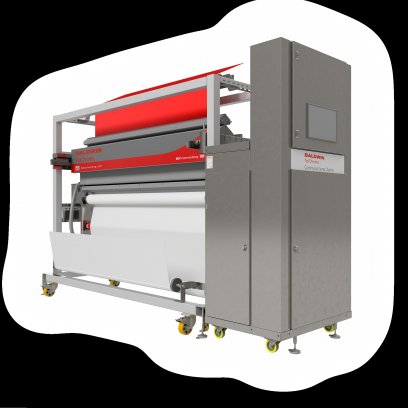
At ITMA Asia + CITME in Singapore, BW Converting presented its Baldwin TexChroma digital spray dyeing system in response to growing global demand for more efficient, sustainable textile coloration technologies.
A member of TMAS, the Swedish textile machinery association, BW Converting introduced TexChroma as part of its expanding portfolio of advanced finishing and dyeing systems, positioning the technology as a response to long-standing challenges in conventional dyehouse operations.
Responding to Market Demand
BW Converting’s presentation reflected increasing pressure on textile manufacturers to reduce water, energy, and chemical consumption while maintaining high-quality color consistency.
“Spray dyeing represented the future, and many of our customers were already seeing the benefits,”
— Yiannis Vasilonikolos, Sales Leader for Textiles
According to the company, TexChroma underwent extensive trials using pigment, reactive, acid, and disperse dyes on both cotton and synthetic fibres. These trials demonstrated compatibility across a wide range of fiber types and production environments.
Production data available at the time indicated potential reductions of more than 30% in energy, dye, and chemical use compared with conventional continuous pad batch dyeing, and up to 50% compared with exhaust reactive dyeing processes.
Precision Through Advanced Chemical Application
A central feature of TexChroma was its ability to mix reactive dyestuffs and alkali fixation chemicals seconds before spray application.
This real-time mixing process eliminated “tailing and listing,” a common issue in traditional dyeing systems that resulted in uneven color application and shade variation. By controlling chemical interaction at the point of application, the system improved consistency across production runs.
For manufacturers managing high-volume output and strict quality requirements, this capability addressed one of the most persistent operational challenges in dyehouses.
Building on the TexCoat G4 Platform
TexChroma’s development followed the commercial success of BW Converting’s TexCoat G4 spray finishing system, which had been widely adopted in Europe, North America, and Asia.
We initially focused on Europe and the United States, but Asia became a major growth region,
— Rick Stanford, Vice President, Global Business Development
More than 35 TexCoat G4 units had been installed across Asian markets in recent years. Feedback from these customers played a key role in shaping demand for a complementary spray-based dyeing solution.
The first industrial TexChroma installation was planned at a major Italian continuous dyeing facility, allowing for full-scale operational testing prior to wider market release.
Cautious Development and Industrial Validation
BW Converting emphasized a deliberate development process before bringing TexChroma to commercial production.
The dyeing process is unforgiving. We had to get it right the first time,
— Rick Stanford
The company selected an experienced partner with established dyehouse expertise and prior TexCoat G4 experience to support validation. This approach minimized operational risk and ensured that early-stage feedback reflected real production conditions.
By focusing on controlled industrial testing, BW Converting sought to reduce implementation challenges for future customers.
TMAS Members Highlight Broader Innovation
In addition to BW Converting’s presentation, several TMAS member companies introduced new technologies at the Singapore exhibition, reflecting broader innovation trends across textile manufacturing.
Kinna Automatic: Robotic Production Systems
Kinna Automatic introduced fully automated robotic lines for pillow and duvet production, along with its Hector industrial sewing machine designed for heavy-duty circular and point stitching of filled textile components.
These systems targeted productivity improvements in home furnishings manufacturing.
Eltex: Real-Time Tension Monitoring
Eltex announced major upgrades to its EyETM tension monitoring system, incorporating electromagnetic brakes and advanced sensors.
This configuration enabled real-time automatic tension adjustment during operation, reducing reliance on manual corrections. The company also highlighted its ACT-R unit, which reduced selvedge yarn waste in rapier weaving systems while maintaining stable pre-winder tension.
Vandewiele Sweden AB: Weft Control Solutions
Vandewiele Sweden AB presented its X4 yarn feeders with integrated accessory displays, alongside IRO Gaugepart modules for tufting looms.
These systems supported improved control over carpet texture, structure, and surface consistency, strengthening the company’s position in weaving and tufting technologies.
Svegea: High-Speed Tubular Production
Svegea demonstrated its EC 50 and EC 200 machines with E-Drive II systems, designed for high-speed production of tubular garment components such as cuffs, collars, and neck tapes.
Linked cutting systems further enhanced production efficiency for apparel manufacturers.
Technology, Sustainability, and Production Efficiency
Collectively, the technologies presented at ITMA Asia + CITME illustrated accelerating efforts to modernize textile production through automation, precision control, and resource efficiency.
BW Converting’s TexChroma system aligned with these trends by addressing:
- Water and chemical reduction
- Energy efficiency
- Color consistency
- Process automation
- Reduced rework and waste
As regulatory requirements and cost pressures continued to increase, such technologies became central to long-term manufacturing competitiveness.
Industry Outlook
The introduction of TexChroma and related systems reflected a broader shift toward digitally controlled, data-driven dyeing and finishing processes.
Rather than incremental improvements to legacy equipment, manufacturers were increasingly evaluating integrated platforms capable of delivering measurable gains in sustainability, quality, and operational resilience.
For textile producers navigating rising input costs and tightening environmental standards, these developments signaled a growing emphasis on precision-engineered solutions.
Conclusion
BW Converting’s presentation of the TexChroma digital spray dyeing system at ITMA Asia + CITME marked a significant step in the evolution of textile coloration technology. Built on the foundation of the TexCoat G4 platform, the system demonstrated how targeted innovation could address long-standing inefficiencies in dyehouse operations.
Alongside advancements from other TMAS members, TexChroma underscored a broader industry movement toward smarter, cleaner, and more adaptable manufacturing systems—linking technical performance with sustainability and commercial viability.
Learn more at 👉 Textile Machinery Association of Switzerland