

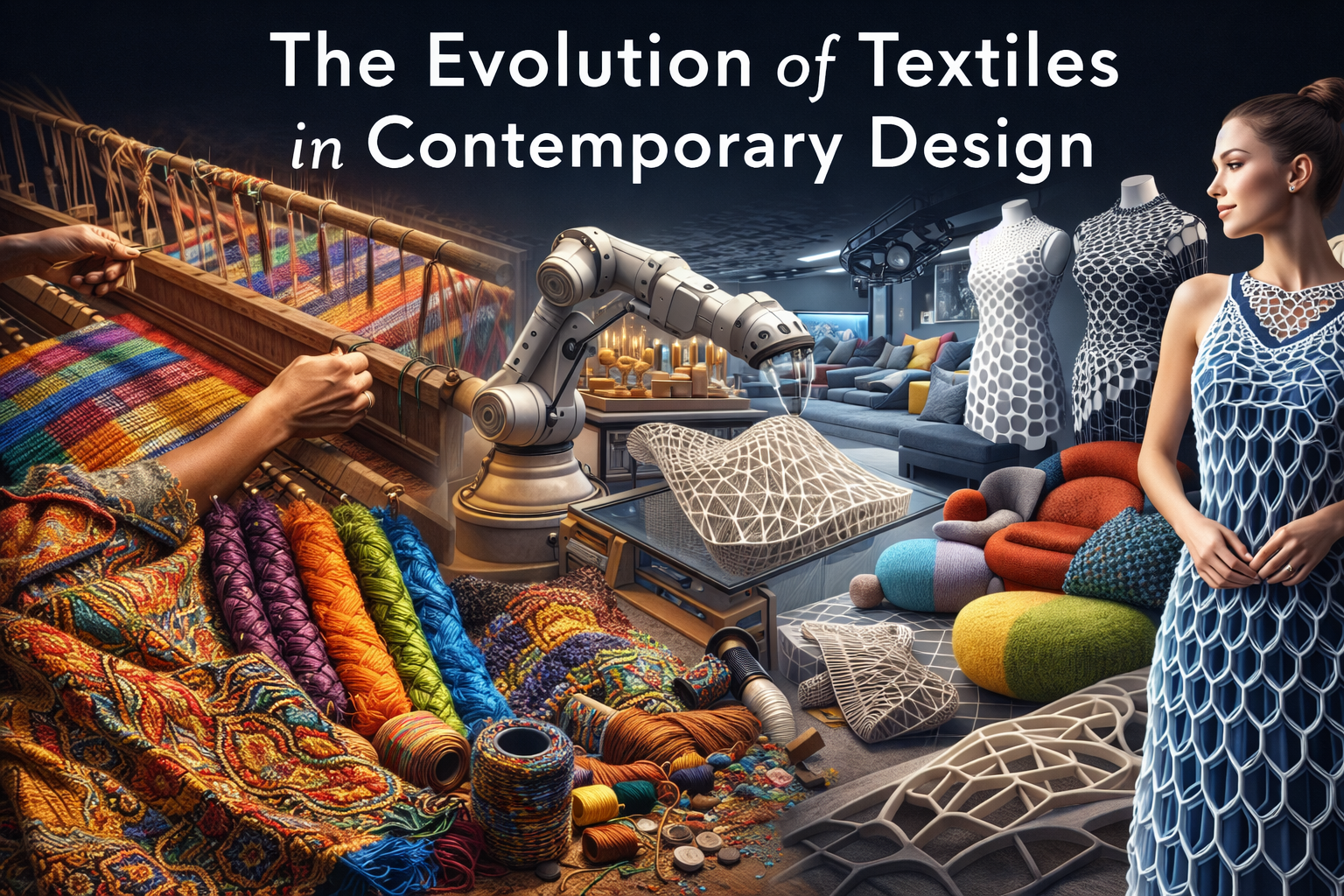
The relationship between textiles and design has undergone a profound transformation. What was once a straightforward selection process—choosing fabrics based on aesthetics, drape, and cost—has evolved into a complex decision-making framework where innovation, sustainability, and technology converge.
“Understanding textiles isn’t optional for contemporary designers—it’s fundamental. The fabric choices we make today determine whether our industry evolves toward sustainability or continues patterns that can’t be sustained. Every material decision is a vote for the future we’re creating.”
From Traditional to Technical
Contemporary textile development bears little resemblance to its historical counterpart. Where designers once chose between wool, cotton, silk, and linen, today’s options include phase-change materials that regulate body temperature, fabrics embedded with conductive fibers for wearable technology, and textiles engineered at the molecular level for specific performance characteristics.
This technical evolution hasn’t replaced traditional materials but rather expanded the designer’s palette. Natural fibers remain essential, yet they’re now enhanced through modern processing techniques. Cotton becomes moisture-wicking through chemical treatments. Wool gains wrinkle resistance while maintaining breathability. Silk blends with synthetic fibers to improve durability without sacrificing luxury.
When Fashion Meets Scientific Innovation

Photo- Pierre Suu | Getty Images
Perhaps no moment better captures contemporary textile innovation than Coperni’s spring 2023 finale at Paris Fashion Week. Bella Hadid walked to the center of the runway wearing only a G-string, holding her breasts, as two technicians began spraying her body with what appeared to be white paint. Within 15 minutes, a dress materialized on her body—one that moved like a second skin, fitting seamlessly and draping naturally as she walked away.
The technology behind this theatrical moment started humbly: with a can of silly string and the curiosity of Dr. Manel Torres. “I thought I could create a mist,” Torres explained in a 2013 TED Talk. “That was the eureka moment.” Torres, who studied fashion design, envisioned spraying on a T-shirt but lacked the technical knowledge to realize it. He approached Imperial College London with his concept. They provided resources—a lab and materials—and after two years of trial and error, results emerged.
In 2003, Torres created Fabrican: a liquid fiber bound with polymers, bio-polymers, and greener solvents that evaporates when the spray reaches a surface. The resulting fabric feels like suede and can be manipulated like traditional textiles—cut, draped, and tailored. The texture varies depending on fibers used (natural or synthetic) and application method.
Coperni designers Sébastien Meyer and Arnaud Vaillant—known for pushing technological boundaries with innovations like their glass handbag—saw potential beyond spectacle. They combined Fabrican with 3D technology to create a custom design built directly onto Hadid’s body in real time. “No rehearsal, no nothing, just passion,” Hadid later posted.
But this isn’t merely fashion theater. The technology has practical applications: repairing damaged clothing, creating custom-fit garments without traditional manufacturing, and extending into medical uses like spray-on sterile bandages or orthopedic casts from aerosol cans.
“Fashion designers need new materials and fabrics to create products to address evolving lifestyles and consumer demands,” the Coperni show notes stated. “In the 21st century we should make it the first time that science and design really march together in close step, illustrating in this way their interdependence.”
The Sustainability Revolution
Environmental concerns have fundamentally reshaped textile innovation. The industry’s response goes beyond marketing—it’s driving genuine material science breakthroughs. Brands invest in closed-loop manufacturing systems where textile waste becomes raw material for new production. Regenerative agriculture practices improve soil health while growing organic cotton and hemp.
Recycled materials have moved from niche eco-collections to mainstream production. Post-consumer plastic bottles transform into performance polyester. Discarded fishing nets become swimwear and activewear. Textile-to-textile recycling technologies allow worn garments to re-enter production cycles, reducing reliance on virgin materials.
Bio-based innovations present alternatives to conventional synthetics. Mycelium leather grows from fungal networks. Algae-derived fibers offer biodegradable performance textiles. Bacterial cellulose produces materials with properties similar to leather and silk, cultivated in laboratory conditions rather than harvested from animals or petroleum.
Digital Design Integration
Technology has revolutionized how designers interact with textiles before physical samples ever exist. Digital fabric libraries allow designers to visualize materials in three-dimensional garment simulations, testing drape, stretch, and appearance under various lighting conditions. This capability reduces sample production, accelerates design cycles, and enables more experimental approaches.
3D knitting technology produces seamless garments with minimal waste, programming complex patterns and structural variations directly into the manufacturing process. Digital printing eliminates traditional screen-making requirements, allowing small-batch custom designs and rapid prototyping previously impossible at commercial scale.
Smart textiles integrate functionality directly into fabric structure. Conductive threads enable touch-sensitive surfaces. Embedded sensors monitor biometric data. Thermochromic dyes change color in response to temperature. These innovations blur boundaries between fashion, technology, and functional design.
Supply Chain Transparency
Contemporary textile sourcing demands unprecedented traceability. Consumers and brands alike require documentation of fiber origins, processing methods, and labor conditions throughout production chains. Blockchain technology creates immutable records tracking materials from raw fiber to finished garment.
This transparency imperative has exposed vulnerabilities in global textile networks while creating opportunities for regional production and alternative supply chains. Designers increasingly value relationships with textile mills and fiber producers, seeking partnerships that prioritize ethical practices and environmental responsibility alongside quality and innovation.
The Designer’s Expanding Role
Today’s designers must be part material scientist, sustainability strategist, and technology integrator. Understanding fiber properties at a molecular level informs better design decisions. Familiarity with manufacturing processes reveals opportunities for innovation and waste reduction. Knowledge of global supply chains enables more resilient sourcing strategies.
This expanded expertise doesn’t diminish creativity—it enhances it. Constraints drive innovation. Sustainability requirements push designers toward novel solutions. Technical possibilities inspire new aesthetic directions. The best contemporary work emerges from deep material understanding combined with creative vision.
Meyer and Vaillant’s Coperni collection exemplified this convergence. Held in the Salle des Textiles at the Musée des Arts et Métiers in Paris, the show presented historical proportions reimagined through contemporary technology: exaggerated hips via padding on tailored wool trousers, holographic floral prints bonded onto neoprene, and slip dresses where vertical fabric panels connect with metallic ringlets. “It’s our celebration of women’s silhouettes from centuries past,” Vaillant explained. “And we wanted to update our aesthetic in a more grown-up and scientific way.”
Looking Forward
Textile evolution continues accelerating. Laboratory-grown materials promise customizable properties designed for specific applications. Nanotechnology enables fabric treatments at microscopic scales. Biodegradable synthetics address end-of-life concerns while maintaining performance characteristics.
The future of textiles isn’t about replacing what came before but building upon centuries of knowledge with modern capabilities. Natural fibers refined through generations of cultivation meet cutting-edge material science. Traditional craftsmanship combines with digital manufacturing. Local production networks leverage global information sharing.
Contemporary design succeeds when it honors textile heritage while embracing innovation—recognizing that the fabrics we choose today shape not just garments, but environmental impact, labor conditions, and the future of an industry in transformation.
The Fabric of Our Future
The evolution of textiles represents more than technological advancement—it reflects our collective reimagining of what fashion can and should be. From Dr. Manel Torres’s spray-on fabric experiments to bio-engineered materials grown in laboratories, we’re witnessing the convergence of centuries-old craft with cutting-edge science. For designers, manufacturers, and industry professionals, the message is clear: material literacy is no longer optional. Understanding fiber origins, production impacts, and innovative alternatives empowers better decisions that balance creativity with responsibility. As consumers demand transparency and sustainability, those who invest in textile knowledge—who understand both the heritage of natural fibers and the potential of emerging technologies—will lead the industry forward. The textiles we develop, select, and champion today won’t just shape tomorrow’s fashion; they’ll determine whether our industry becomes a model for sustainable innovation or remains tethered to practices the planet can no longer support. The fabric is in our hands. What we weave with it matters.