

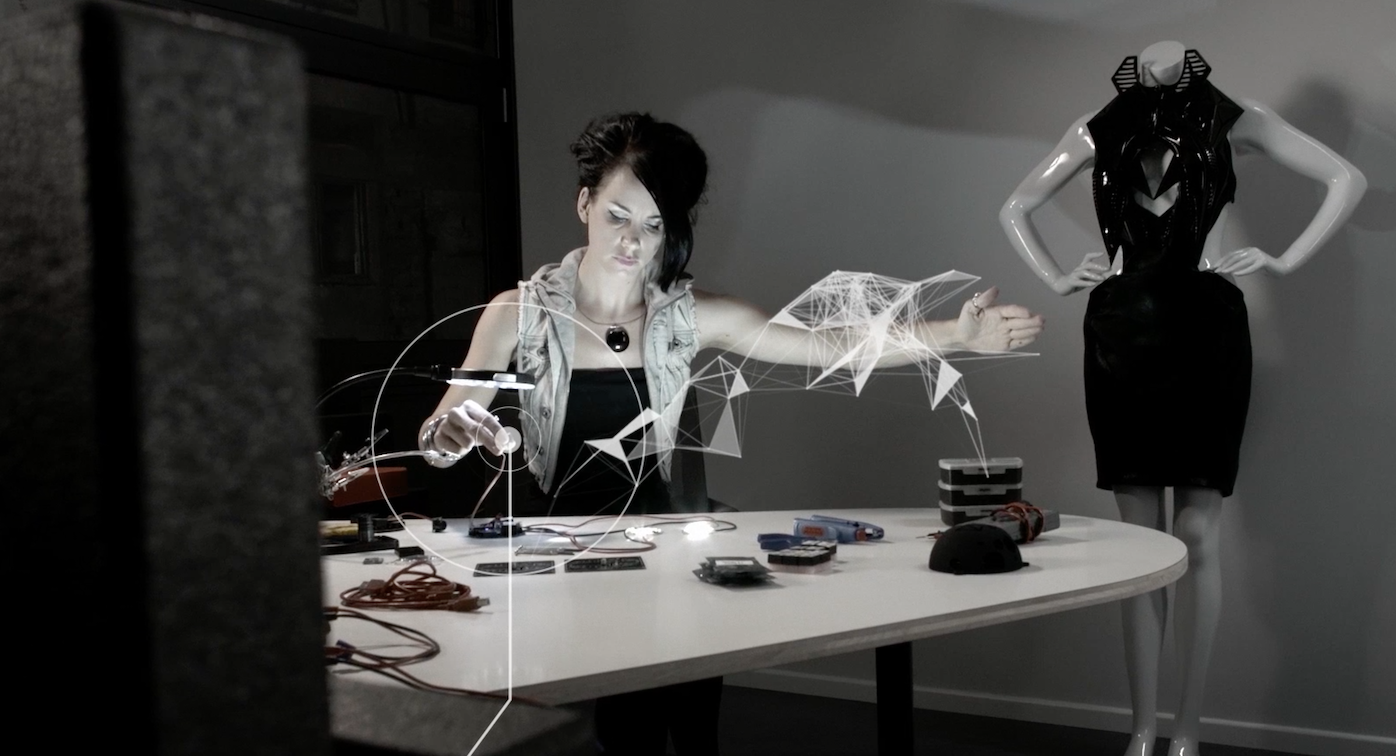


In an industry still largely defined by fabric, silhouette, and surface, Anouk Wipprecht operates in an entirely different dimension—one where garments think, react, and communicate. Her work doesn’t simply dress the body; it transforms clothing into an interface between human emotion, environment, and machine intelligence.
For a publication like Garment District News, Wipprecht represents a critical inflection point: the moment when the supply chain of fashion collides with robotics, AI, and embedded systems.
The Rise of “FashionTech”
Wipprecht is widely recognized as a pioneer in FashionTech, a discipline that merges fashion design with engineering, robotics, and interaction design.
Her philosophy is simple but radical:
garments are not passive objects—they are active systems.
Her designs integrate:
- Microcontrollers and sensors
- Robotics and animatronics
- Machine learning and behavioral response systems
- Biometric data (heart rate, stress, proximity)
The result is what she describes as “fashion as interface”—clothing that mediates how we experience and respond to the world around us.
Early Foundations: From Couture to Code
Wipprecht’s path began unusually early. She started studying fashion at age 14 and later expanded into electronics and interaction design, including work with Arduino-based systems and wearable computing.
This dual foundation—traditional fashion training + embedded technology—is what distinguishes her from both designers and engineers. She does not “add tech to fashion”; she designs garments as technological ecosystems from the start.
Signature Works: Garments That Respond
1. The Spider Dress (2015)


Perhaps her most iconic piece, the Spider Dress uses proximity sensors and robotic arms to defend the wearer’s personal space. When someone gets too close, the mechanical limbs extend outward in a threatening gesture.
GDN Insight:
This is not costume—it’s behavioral design. The garment enforces social boundaries, turning clothing into a psychological tool.
2. The Smoke Dress (2012)


The Smoke Dress emits clouds of smoke when someone approaches, effectively allowing the wearer to “disappear.”
GDN Insight:
This piece reframes concealment—not as fabric layering, but as dynamic environmental manipulation.
3. The HeartBeat Dress


Using biosensors, this dress visualizes the wearer’s heartbeat through light and sound, effectively broadcasting emotional states.
GDN Insight:
Emotion becomes visible. This is the beginning of emotive textiles—a category with massive implications for performance wear, healthcare, and storytelling.
4. The Drinkbot Dress


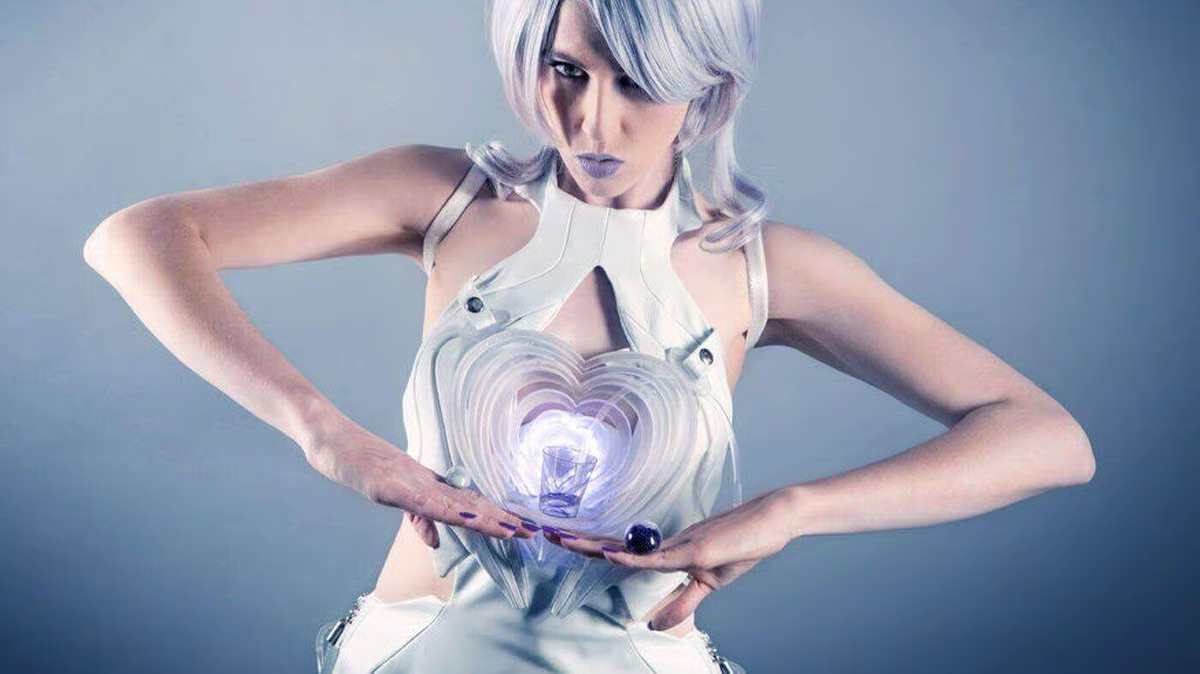
A playful yet technically complex garment, the Drinkbot Dress mixes and serves cocktails via an embedded pump system.
GDN Insight:
Hospitality, performance, and fashion converge—hinting at functional garments in experiential environments (events, entertainment, immersive retail).
Engineering the Garment: Inside Anouk Wipprecht’s Technology Stack
What sets Anouk Wipprecht apart is not simply her aesthetic—it is her methodology. Her garments are not constructed like traditional apparel; they are engineered like systems. Each piece begins not with fabric alone, but with architecture: a layered integration of electronics, mechanics, and responsive intelligence.
At the core of her work are microcontrollers—often platforms like Arduino or Intel Edison—that function as the garment’s “brain.” These are paired with an array of sensors capable of reading the world around the wearer: proximity sensors that detect movement and distance, biometric inputs that register heartbeat or stress, and environmental sensors that interpret external conditions.
From there, the system extends outward through actuators—motors, robotic elements, and pneumatic mechanisms—that translate data into physical motion. This is where her garments come alive: panels expand, limbs extend, structures react. Encasing these systems are often 3D-printed exoskeletal forms, giving her work its signature hybrid of couture and machine.
Layered over all of it is behavioral logic—algorithms that determine how the garment responds. The result is clothing that doesn’t just function, but decides. A Wipprecht piece can detect a presence, interpret intent, and respond in real time—autonomously.
In this context, her garments are not worn. They are activated.
A New Industrial Alliance: Fashion Meets Technology
Wipprecht’s work has drawn the attention of some of the most influential technology and creative organizations in the world. Collaborations with Intel, Autodesk, Google, and Microsoft highlight the technical rigor behind her designs, while partnerships with Cirque du Soleil, Audi, and Swarovski underscore their performative and cultural impact.
This convergence signals something larger than collaboration—it marks the emergence of a new supply chain. Fashion is no longer operating in isolation. Instead, it is increasingly intertwined with semiconductor production, robotics engineering, automotive innovation, and immersive entertainment.
For Garment District News, this is the story beneath the spectacle: a structural shift in how garments are conceived and produced.
Beyond the Aesthetic: What Her Work Reveals
Wipprecht’s designs are often labeled “futuristic,” but that framing undersells their significance. These garments are less about predicting the future and more about exposing a transformation already underway.
First, they redefine clothing as behavior. Her pieces actively shape how people interact—controlling personal space, signaling emotional states, and altering social dynamics. Clothing becomes a participant, not a passive layer.
Second, they reposition the human body itself. The wearer is no longer simply dressed; they become a host system. Technology integrates directly with the body’s signals and surroundings, blurring the boundary between human and machine.
Third—and perhaps most critically—they point to a fundamental shift in the garment lifecycle. A future Wipprecht-inspired piece is not just sewn; it is manufactured, programmed, and maintained. It requires electronics supply chains, software development cycles, firmware updates, and long-term servicing infrastructure.
This transforms every stage of the industry:
design becomes systems engineering,
production becomes hybrid fabrication,
distribution expands to include technical components,
and ownership begins to resemble stewardship of a device.
The GDN Perspective: From Costume to System Design
From the vantage point of Garment District News, Wipprecht’s work sits at a powerful intersection. It draws from costume design’s narrative sensibility, where garments respond to story and character. It pushes textiles into the realm of responsive materials. It forces manufacturing to reconcile soft goods with hard technology. And it extends logistics into entirely new territories—where garments may ship with circuitry, require calibration, or demand post-sale support.
Her creations already feel at home in science fiction film, immersive theater, and high-concept editorial work. But their implications extend far beyond performance environments.
They suggest a future where garments are no longer static products. They are platforms—upgradable, responsive, and deeply integrated into the systems around them.
Final Thought
Anouk Wipprecht is not simply designing clothing—she is prototyping a new relationship between humans and the things they wear.
In her world, a dress can defend its wearer, reveal their emotional state, serve a function beyond aesthetics, or disappear entirely into its environment.
The question her work leaves behind is not about style or trend.
It is foundational:
When clothing becomes intelligent, what does it mean to wear it—or does it begin to wear us?