


There is a particular kind of travel that does not begin with sightseeing. It begins with a question: Where does this material come from, and who still knows how to make it?
For Sarah Light, owner of The Tour Studio, that question sits at the center of her work. Her textile journeys are designed for people who want more than a beautiful itinerary. They are created for designers, makers, educators, costume professionals, fiber artists, and textile lovers who want to understand craft through place, process, and human connection.
In Greece, that vision finds especially fertile ground.
From Athens to the Peloponnese, The Tour Studio’s textile-focused journey follows a living thread through museum collections, heritage workshops, regional landscapes, and traditional weaving studios. At the heart of the experience is Tsakonian kilim weaving, a rare and deeply rooted textile tradition still practiced by third-generation weaver Elisavet Rodopoulou in Tyros, near Leonidio.
For Light, textile tourism is not simply about learning a technique. It is about entering the world around that technique.
“The beauty of textile travel,” she explains, “is that you are not separating the object from the people, the landscape, or the history that made it possible.”
A Different Kind of Creative Education
The Tour Studio’s approach reflects a growing hunger among creatives for slower, more meaningful forms of learning. In a design world increasingly shaped by digital references, rapid sourcing, and online inspiration, textile tourism offers something different: proximity.
Participants are not just looking at images of rugs, trims, embroideries, or woven cloth. They are standing in the rooms where these objects are made. They are watching hands move across fiber. They are listening to stories from people who inherited their skills through family, region, and repetition. They are seeing how color, material, and pattern are shaped by geography.
That direct contact changes the way people think about textiles.
A fabric is no longer only a surface. A rug is no longer only an object. A motif is no longer just decoration. Each becomes evidence of place, labor, memory, and cultural continuity.
This is what makes Greece such a compelling destination for The Tour Studio. The country’s textile history is layered and expansive, stretching from ancient weaving practices to regional dress, religious textiles, embroidery, passamenterie, domestic production, rug making, and contemporary studio work.
For Light, Greece allows participants to see textiles as both heritage and daily life.
“A textile journey does not just show you cloth. It shows you where memory becomes material.”
Beginning in Athens
The journey begins in Athens, where the past and present sit close together.
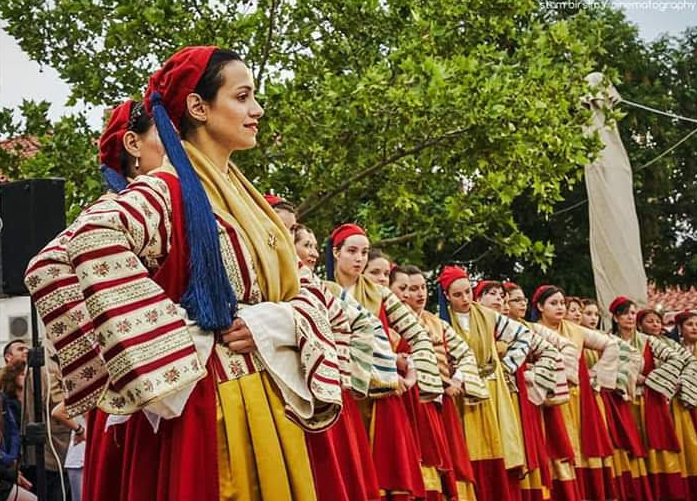
Before participants move into the slower rhythm of the Peloponnese, they first encounter Greece’s textile heritage through museums, collections, and historic workshops. These spaces help establish the larger cultural framework: how textiles appear in costume, ritual, domestic life, religious practice, performance, and identity.
This matters because The Tour Studio’s trips are not designed as isolated workshops. The workshop is only one part of the story. Before participants sit at a loom, they are invited to understand why the loom matters.
Athens becomes the introduction. It gives participants the visual and historical vocabulary they need before they enter the weaving landscape.
Decorative trimming, embroidery, woven bands, regional garments, and historic textiles begin to reveal how deeply cloth has shaped Greek culture. For designers and costume professionals, this context is especially valuable. It helps them understand fabric not only as material, but as communication.
Moving Toward the Peloponnese
From Athens, the journey moves south into the Peloponnese.
The transition is essential. The pace changes. The light changes. The relationship to land becomes more visible. Coastal towns such as Nafplio and mountain-framed communities near Leonidio introduce participants to a landscape where weaving traditions are still connected to regional identity.
Here, design education becomes sensory.
The colors of stone cliffs, sea light, olive groves, village architecture, and local wool begin to inform the eye. Participants start to understand that textile traditions do not develop in abstraction. They emerge from specific environments, climates, economies, and communities.
For many travelers, this is the moment the experience becomes more than a class.
It becomes a way of seeing.
Inside the Tsakonian Weaving Tradition
In Tyros, near Leonidio, the journey reaches one of its most meaningful points: the family studio of Elisavet Rodopoulou.
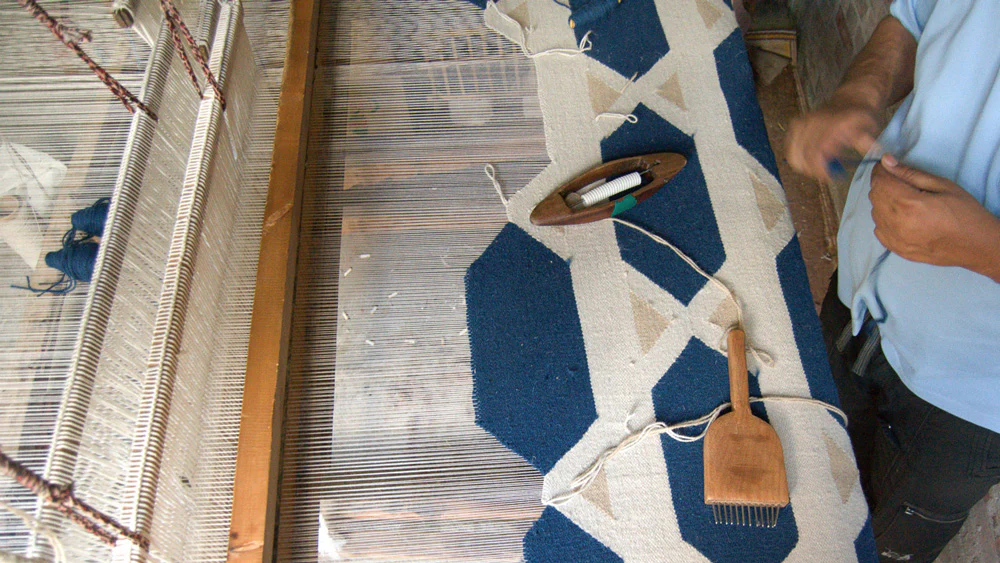
Rodopoulou is a third-generation weaver whose family has helped preserve the Tsakonian kilim tradition for decades. Her studio serves as both a working space and a living archive, carrying forward a form of weaving that once had a wider regional presence but is now sustained by a small number of practitioners.
For The Tour Studio, this is precisely the kind of encounter that defines responsible textile tourism.
Participants are not watching craft from a distance. They are learning directly from a maker whose knowledge comes through family lineage, repetition, regional memory, and lived practice.
The workshop experience introduces the full physical reality of weaving. Participants may observe or take part in preparing vertical looms, handling wool, studying traditional kilim structures, understanding pattern symbolism, and weaving small-scale pieces by hand.
The process is intimate and demanding.
Working at a loom teaches what a photograph cannot: tension, rhythm, posture, patience, resistance, and the limits of material. Every decision has weight. Every thread depends on the one before it.
For designers accustomed to fast sampling, digital mood boards, or industrial production timelines, the experience can be transformative. Handweaving does not allow the maker to rush past the material. It asks for attention.
Why This Matters for Designers
The Tour Studio’s Greece journey is especially relevant for people working in fashion, costume, interiors, textile design, and craft education because it reconnects design with origin.
A costume designer might leave with a deeper understanding of how regional textiles can shape character and place. A fashion designer may begin to think differently about surface, weight, color, and sourcing. A fiber artist may gain new respect for inherited structures and traditional tools. An educator may see how place-based learning can bring textile history alive for students.
For Light, this is part of the deeper purpose of the trip.
Textile tourism is not about copying tradition. It is about learning from it with care.
The goal is not to extract motifs or turn heritage into trend. The goal is to understand the systems behind the textile: the people, the sheep, the wool, the dye, the loom, the region, the family, the economy, and the story.
That understanding can make contemporary work more thoughtful, more grounded, and more respectful.
Heritage as a Living Practice
One of the most powerful aspects of The Tour Studio’s model is its emphasis on living traditions.
Tsakonian kilim weaving is not presented as something frozen in the past. It is shown as a practice that continues because people continue to teach it, support it, purchase it, and value it.
This is where textile tourism can play an important role in preservation.
When travelers learn directly from local makers, they help support independent studios and regional economies. They also participate in the transmission of knowledge. Even if they do not become master weavers, they leave with a greater understanding of what is at stake when a craft tradition disappears.
A handmade textile carries more than pattern. It carries time, technical intelligence, family history, and cultural memory.
Through The Tour Studio’s itinerary, participants are invited to recognize that value.
Community Around the Loom
The social dimension of the journey is just as important as the technical one.
The people who join textile-focused trips often come from different backgrounds. Some are professional designers. Some are artists. Some are educators. Some are serious enthusiasts who simply want to understand cloth more deeply.
Once they are gathered around a loom, those categories begin to soften.
People exchange references. They compare techniques. They talk about sourcing, archives, sustainability, costume, interiors, craft, and personal practice. Meals become part of the education. Travel time becomes conversation time. The group itself becomes a temporary creative community.
For many participants, that network continues after the trip ends.
This is one of the quiet strengths of textile tourism. It does not only connect travelers to a destination. It connects them to one another.
Greece as Teacher
What makes the Greek journey so memorable is that the country itself becomes a teacher.
Athens offers history and context. The Peloponnese offers landscape and pace. Tyros offers direct contact with a living weaving tradition. Elisavet Rodopoulou’s studio offers the intimacy of inherited knowledge. Together, these elements create an experience that cannot be replicated through a lecture, a video, or a museum visit alone.
For The Tour Studio, this is the real promise of textile travel.
It is education through movement.
It is design research through experience.
It is preservation through participation.
It is creativity rooted in place.
Weaving the Past Into the Future
Sarah Light’s work with The Tour Studio points to a larger shift in how creative people want to learn. Designers are no longer satisfied with surface-level inspiration. They want to understand the origin of materials, the hands behind techniques, and the cultural systems that give textiles meaning.
In Greece, that desire becomes tangible.
A kilim is not simply woven. It is inherited, taught, adapted, and carried forward. A workshop is not simply a class. It is a meeting point between generations. A journey is not simply travel. It is a way of entering a textile tradition with humility and curiosity.
For Garment District News readers, The Tour Studio’s Greece experience offers a compelling reminder: the future of design depends not only on innovation, but on relationship.
Relationship to material.
Relationship to maker.
Relationship to place.
Relationship to history.
And in the quiet rhythm of a loom in the Peloponnese, those relationships are still being woven by hand.

Disclosure: Garment District News is not sponsoring, organizing, or financially affiliated with this textile travel experience. This article is for editorial and informational purposes only. Interested readers can learn more or register directly through the program organizer.
Tags: Feature Travel-Tourism