

Wool’s End of Life Story: A Wool Merchant’s Experiment
When we talk about sustainable textiles, the conversation usually focuses on where a fibre comes from. But wool’s end of life merits attention.

Wool’s credentials at the production end are well established: wool is a natural, renewable resource, grown annually on sheep. It is also clear that wool textiles can be washed less frequently than those of other fibre types, and that airing wool garments in
between wears makees them last longer and saves on energy consumption. But what about wool at the end of its useful life?
One of our members in Japan, Ken Nagao of Nagao Shoji K.K. decided to find out for himself.
Do-It-Yourself Biodegradability
Ken Nagao started in the wool trade at 22 years old. His business today – which he runs along with seven other sales reps, three of them his sons – supplies wool to textile manufacturers across Japan and Asia. With nearly 50 years in the business, Ken has spent years making the case for wool bedding in Japan, a market dominated by synthetic feathers and down.
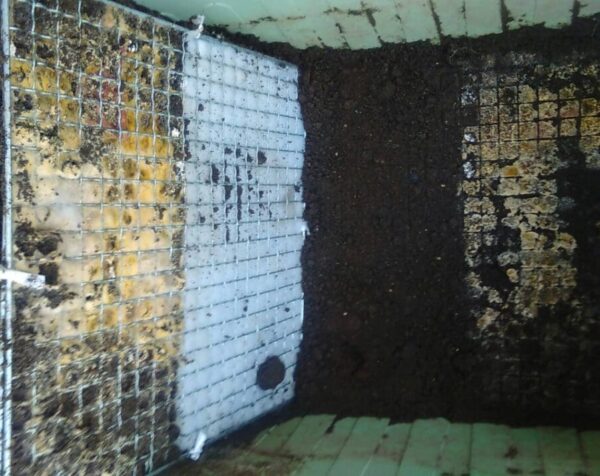
To bring the facts home, he designed an experiment to compare wool and polyester fabrics right on the premises of Nagao Shoji. Ken buried samples of 100% wool fabric and 100% polyester fabric in planters in March 2021. The samples remained buried for six months. They were then dug up and sent to the Japan Textile Products Quality and Technology Center (QTEC) for analysis.
The image shows the samples after six months buried in soil. The wool sample is on the left, almost completely disintegrated. The polyester sample is on the right.
QTEC Results
QTEC conducted independent analysis of the fabric samples. Using scanning electron microscopy, QTEC confirmed that the wool fabric degraded almost completely in those four months. Infrared analysis identified what remained of the sample as protein: the wool in the process of returning the amino acids it is made of to the soil.
The polyester samples showed no change.
QTEC further identified the protein of the degrading wool to 19 amino acids. Wool is not merely disappearing into the soil when it biodegrades, but actively enriches it with nitrogen, phosphate, and potassium.
Polyester offers none of these things.
Why Wool Behaves This Way
Wool is a protein fibre, built from the same keratin that is found in human hair. Wool’s biological origin means that when it is introduced into soil, micro-organisms recognise it as nourishment.
As the Nagao experiment showed, wool can biodegrade in soil in as little as three to four months. The precise rate depends on soil type, climate, and the wool’s characteristics.
In contrast, synthetics could take hundreds of years to break down. In the process, petroleum-based fibres and fabrics will release microplastics – the opposite of nourishment for soils and aquatic systems alike.
Read more about wool biodegradability
Practical Product Design Supports Easy End of Life Uses
Ken Nagao’s work raises a practical point for manufacturers of bedding such as futons, duvets, and pillows. If these items have accessible inner wool filling, it makes it easier for consumers to separate and compost the wool when the time comes.
For urban consumers without large garden spaces, smaller pots and planters can readily accommodate wool cut into pieces. Whether the wool goes into the ground or a pot, it will act as an insulator, moisture regulator, and fertiliser.
Read more about how wool fertilises.
Wool and polyester fibres under the microscope.


The post Wool’s End of Life Story appeared first on International Wool Textile Organisation.