

The designer behind sculptural bioplastic garments is proving that innovation doesn’t require a factory—sometimes it just requires a stovetop and unwavering vision.
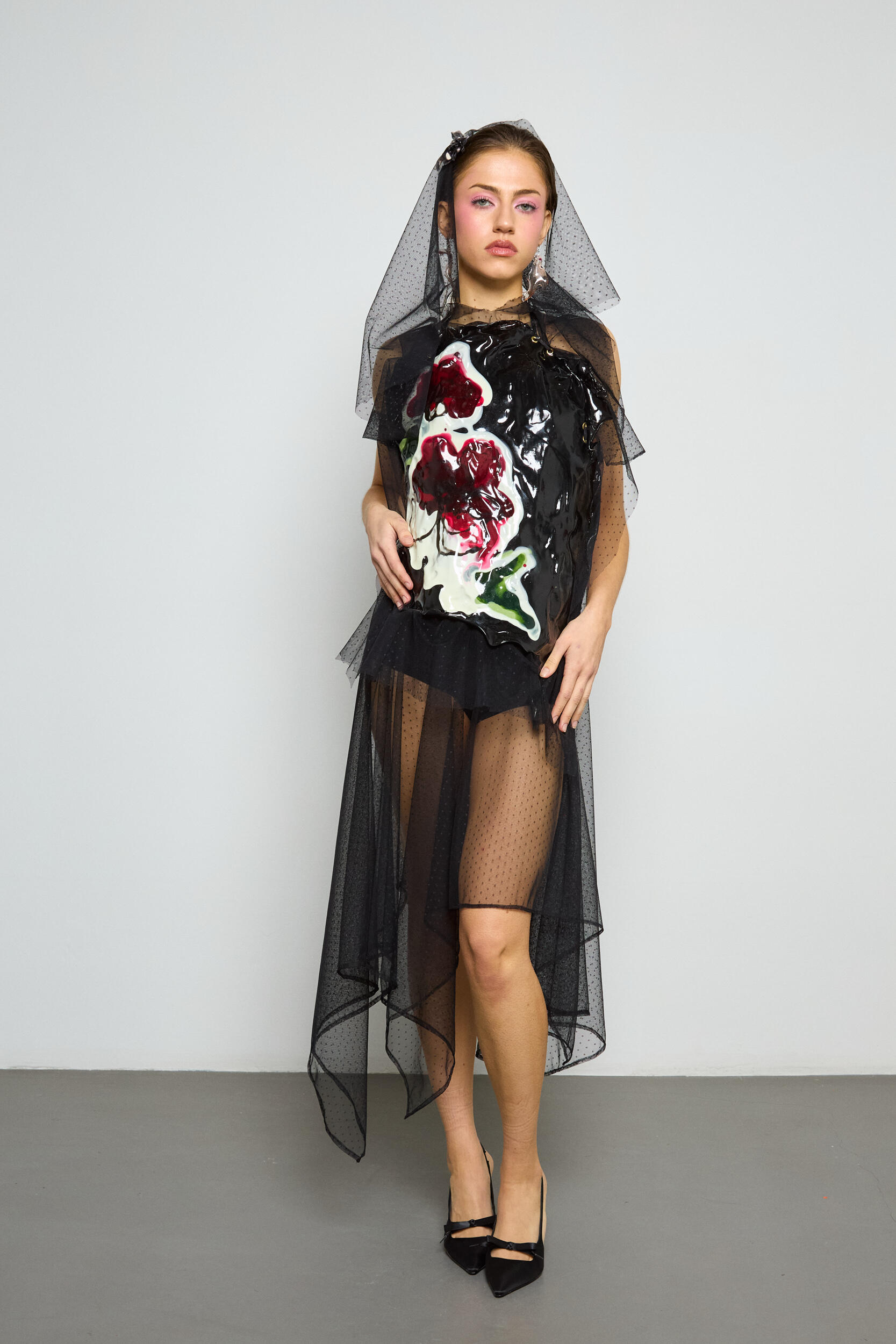
Caroline Zimbalist makes her fashion collections the same way other people make jam. She stands at a portable burner in her Long Island City apartment, heating a mixture of agar, glycerine, pea powder, and corn starch in an old Cuisinart pot. As the ingredients liquefy into a translucent gel, she adds natural pigments—turmeric for yellow, spirulina for green, beet juice for pink. Then she pours the molten bioplastic onto fabric or into molds, shaping it with her hands and household objects while it’s still warm, watching as it hardens into sculptural forms that look like crystallized flowers, abstract landscapes, or artifacts from a world where nature and technology have merged.
This is not performance art. This is not a gimmick. This is literally how Zimbalist creates the garments that have appeared at New York Fashion Week multiple times, on Chappell Roan at major events, and in the Whitney Museum gift shop.
From Poison to Patent-Pending Innovation
Zimbalist’s path to bioplastics began with accidental self-poisoning. A Parsons graduate who studied experimental knitwear at Central Saint Martins in London, she was working with acrylic paint skins, trying to create custom textiles for her designs. The toxic fumes made her sick. A professor suggested exploring biomaterials instead. A book called The Bioplastic Cook Book provided recipes. From there, Zimbalist spent months experimenting, failing, adjusting ratios, testing temperatures, until she developed her own patent-pending mixtures—one that dries rigid for vessels and sculpture, another engineered to remain flexible and breathable enough for clothing.
The breakthrough wasn’t just technical. It was conceptual. Zimbalist realized she could create entirely new textiles that didn’t exist in nature or industry, materials that were biodegradable and handmade, that carried her aesthetic vision in their very molecular structure. She wasn’t just designing garments anymore. She was inventing the fabric itself.
Environmental Grief as Creative Fuel
The work is grounded in loss. Zimbalist grew up watching vines grow wild near her childhood home, a tangle of green that felt eternal until developers chopped it down. That experience—watching nature disappear for the sake of progress—became the emotional core of her practice. Her collections imagine a future where the natural world has vanished and humans create synthetic replicas of what’s been lost. But there’s also fantasy here, whimsy, an insistence on beauty even in dystopia.
Her Fall/Winter 2024 and Spring/Summer 2025 collections pushed bioplastics from experimental curiosity to fully realized eveningwear. She layered molded bioplastic over silk, cotton, and tulle, creating dresses with petal-like structures and watercolor gradients that shift as light hits them. She collaborated with accessory designers to create bioplastic buttons, rings, and shoes, proving the material could work beyond garments. Each piece takes hours to create—pouring, drying, shaping, attaching to fabric—with variations in humidity and temperature affecting every batch.
For Fall/Winter 2025, she introduced hand-drawn prints on fabric that blend with layered bioplastic—illustrations of a natural world clinging to beauty while surrounded by waste. The prints show flowers growing from garbage, vines overtaking abandoned structures, nature persisting despite everything working against it.
Beyond the Kitchen: Scaling Handmade Innovation
Zimbalist has shown at New York Fashion Week multiple times, been featured in Teen Vogue, and created a large commission for a cruise ship centered on sustainability. Her work sells through the Whitney Museum, Ssense, 1st Dibs, and the Museum of Craft and Design. An upcoming linens collection with ABC Carpet & Home will bring her bioplastic aesthetic into home goods—pillows, table runners, decorative objects that carry the same sculptural, nature-inspired forms as her garments.
She’s collaborated with designers like Elena Velez and Injury, created custom pieces for musician Chappell Roan, and regularly fields requests from stylists looking for something utterly unique. Because that’s what Zimbalist offers: garments that literally cannot be found anywhere else, that don’t exist until she makes them.
But she’s also navigating the central challenge of her practice—how to scale a process that’s fundamentally handmade. She works as a CAD designer for a New York clothing company to support herself while maintaining her own practice. She’s researching potential collaborations that could expand production without sacrificing the handmade quality that defines her work. She’s exploring which parts of the process could be delegated and which must remain in her control to maintain the vision.
The Garment District as Foundation
For Zimbalist, the Garment District offers access to traditional textiles that serve as canvases for her bioplastic innovations. She sources silks, cottons, tulles, and specialty fabrics from suppliers who’ve been operating for generations. She finds trims and notions that ground her futuristic visions in wearability. The district’s infrastructure—the density of specialized knowledge, the ability to source small quantities of unusual materials, the ecosystem of makers and suppliers—makes her work possible.
She’s also teaching now, sharing her bioplastic process through workshops and informal mentorship. The recipes aren’t secret—she wants others to experiment, to discover their own applications for biodegradable materials. She sees biomaterials as one answer to fashion’s environmental crisis, but only if the knowledge spreads beyond a handful of experimental designers.
What’s Next: Expansion Without Compromise
Zimbalist is currently developing new bioplastic formulas, testing different base ingredients and additives to expand the range of textures and applications. She’s exploring larger-scale commissions, considering partnerships that could bring her work to broader audiences while maintaining the handmade quality that makes it special.
The home goods collaboration with ABC Carpet & Home represents one model for growth—taking her aesthetic and process into a different product category where the handmade nature adds value rather than limiting production. She’s also in conversation with several accessory brands interested in bioplastic applications, where small-batch production is already the norm.
But what drives Zimbalist isn’t commercial success or scaling to meet market demand. It’s the belief that fashion can be beautiful, sustainable, and utterly unique, all at once. That innovation doesn’t require factory infrastructure or venture capital. That sometimes the most radical thing you can do is heat ingredients on a stovetop in your apartment and pour them into shapes that didn’t exist before you imagined them.
Her studio apartment in Long Island City isn’t a limitation. It’s a laboratory. The portable burner isn’t a placeholder until she can afford proper equipment. It’s the tool that makes the work possible, that keeps production immediate and intimate and under her control.
From biodegradable buttons to full eveningwear collections, from the Whitney Museum to Fashion Week runways, Zimbalist is proving that the future of sustainable fashion might not look like massive recycling facilities or high-tech laboratories. It might look like an artist in her kitchen, cooking up beauty from agar and imagination, one carefully poured batch at a time.
Designer Snapshot
Name: Caroline Zimbalist
Brand: Caroline Zimbalist
Location: Long Island City, Queens
Background: Parsons graduate, studied experimental knitwear at Central Saint Martins
Signature Style: Sculptural bioplastic garments, accessories, and vessels—handmade, biodegradable, fantasy-meets-environmental consciousness
Retail: Whitney Museum, Ssense, 1st Dibs, Museum of Craft and Design
Collaborations: Elena Velez, Injury, Chappell Roan, ABC Carpet & Home (upcoming)
Follow: @carolinezimbalist | carolinezimbalist.com