

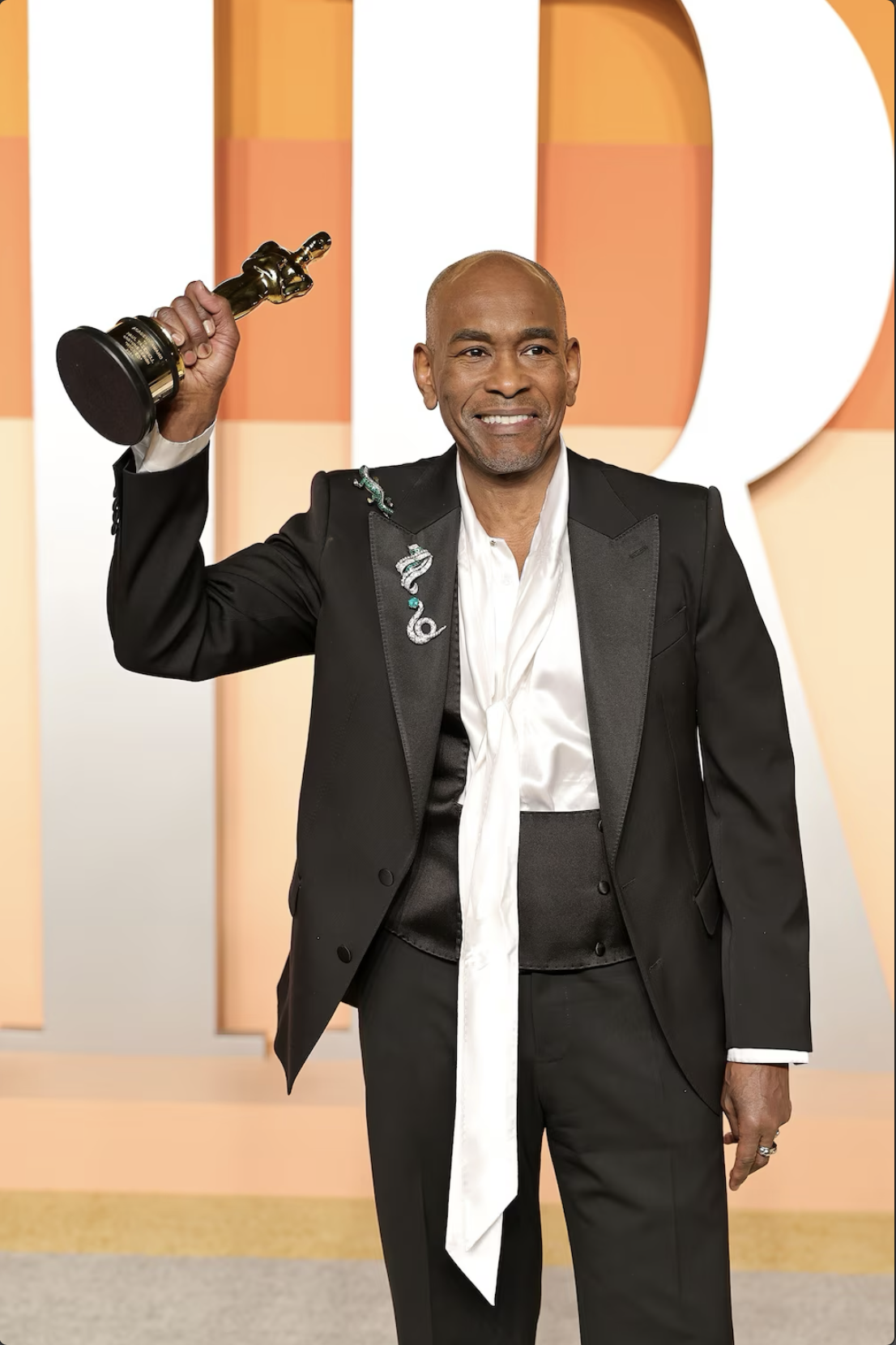
The costume designer behind Wicked just became the first Black man to win an Academy Award for costume design, capping a three-decade career built on storytelling through fabric.
There’s a photo from 1980 that Paul Tazewell keeps close. He’s sixteen, standing in his high school auditorium in Akron, Ohio, wearing a white suit and cape he sewed for himself while playing the title role in a production of The Wiz. His mother made the cape. He designed all the other costumes. Four decades later, Tazewell would return to the world of Oz—this time creating over a thousand costumes for director Jon M. Chu’s film adaptation of Wicked, work that would earn him an Academy Award and cement his place in fashion and film history.
The win in March 2025 made Tazewell the first Black man to receive the Oscar for costume design, following Ruth E. Carter as only the second Black costume designer overall to claim the honor. But for anyone who’s followed his career—from Broadway’s Hamilton to Spielberg’s West Side Story—the recognition felt less like a surprise and more like an inevitability. Tazewell doesn’t just dress characters. He builds entire worlds, stitch by careful stitch.


The Education of a World-Builder
Tazewell’s path to costume design wasn’t linear. He started at Pratt Institute studying fashion, drawn to the craft his mother taught him at age nine on her Singer sewing machine. But fashion felt too limiting, too focused on the runway when what excited him was narrative, character, the way clothing could tell stories that dialogue couldn’t. He transferred to the North Carolina School of the Arts, then NYU’s Tisch School, graduating with an MFA in costume design and a clear vision: he wanted to create clothes that lived in specific worlds, worn by specific people with specific histories.
His Broadway debut came in 1996 with Bring in ‘Da Noise, Bring in ‘Da Funk, earning him his first Tony nomination. Over the next two decades, he’d rack up eight more Tony nods, winning twice—for Lin-Manuel Miranda’s Hamilton in 2016 and Death Becomes Her in 2025. He costumed The Color Purple, In the Heights, Memphis, Ain’t Too Proud, and countless others, often focusing on productions centered on Black and Latino communities. His theater work earned him an Emmy for The Wiz Live! in 2016, proving he could translate his vision across mediums.
But it was film that would test his ability to work at epic scale while maintaining the intimate detail that defines his approach.
From Stage to Screen: The Wicked Challenge
When Chu brought Tazewell onto Wicked, the task was monumental. The Broadway production had been running since 2003, beloved by millions. The 1939 Wizard of Oz had created some of cinema’s most iconic costumes—Dorothy’s ruby slippers sit in the Smithsonian. Tazewell had to honor both legacies while creating something entirely new, something that would hold up in IMAX close-ups and feel true to characters audiences thought they already knew.
He spent a year and a half in the UK, working with a team of seventy artisans. Together, they created twenty-five looks each for Glinda and Elphaba, plus multiples for stunts and covers, plus hundreds more for day players and background actors filling Nathan Crowley’s massive sets for Emerald City, Shiz University, and Munchkinland.
His approach was grounded in research and rooted in nature. For Elphaba, played by Cynthia Erivo, he studied mushrooms, tree bark, root systems—the textures and patterns you see when you turn over a log in a forest. Her costumes feature micro-pleated chiffon applied in undulating wave patterns that look like velvet from a distance but reveal themselves as textural and sinuous up close. The mushroom-inspired patterning connects her to the earth, to animals, to the organic world she fights to protect. Her signature color is black, a choice Tazewell describes as both mourning for her mother and a mark of her distinctive style.
Glinda, played by Ariana Grande, lives in a world of iridescence and translucence, spiraling patterns and Victorian-inspired detail reimagined for an Oz-ian fantasy. Her bubble dress—a modern, sculptural interpretation of Billie Burke’s pink gown from the 1939 film—took 225 hours to create. Sixteen layers had to be snapped on. Grande described the contrast between the dress’s lightness and the emotional weight of the scene where she wears it, announcing Elphaba’s death. That’s Tazewell’s genius: beauty and meaning inseparable, costume as character work.


The Garment District Connection
While Wicked was filmed in the UK, Tazewell’s career has deep roots in New York’s textile and production community. His Broadway work meant decades of collaboration with Garment District fabricators, trim suppliers, and specialty workshops. The district’s infrastructure—the ability to source unusual materials, work with skilled tailors, prototype quickly—shaped his understanding of what’s possible when you combine vision with craft.
He’s also become an educator, teaching workshops and recently establishing a merit-based scholarship for undergraduate students of color at UNC School of the Arts, where he earned his bachelor’s degree. This fall, he’ll teach at FIT, sharing not just design techniques but the broader philosophy that guides his work: that costumes aren’t decoration, they’re storytelling. That detail matters. That research and historical grounding create authenticity even in fantasy worlds.
Beyond the Oscar
The Wicked win brought Tazewell a flood of recognition—a BAFTA, a Critics Choice Award, the Costume Designers Guild’s Excellence in Sci-Fi/Fantasy Film award, an NAACP Image Award. He’s already costumed Wicked: For Good, the sequel releasing later this year, featuring Glinda’s wedding dress and a shimmering purple-blue gown that’s generating buzz before audiences have even seen it.
He’s also designed an exclusive collection for Target, launching in October 2024, bringing elements of his Wicked aesthetic—asymmetry, deconstruction, spiraling patterns, Victorian detail—into everyday wear. It’s a full-circle moment for someone who started in fashion school, now making his world-building accessible beyond theater and film.
An exhibition of his work will open at Chicago’s Griffin Museum of Science and Industry later this year, featuring artifacts from throughout his career, including pieces from Wicked, West Side Story, and Hamilton. It’s a retrospective for a designer still very much in motion, still creating, still finding new ways to tell stories through the architecture of clothing.
Tazewell represents something increasingly rare in contemporary design: someone who moves fluidly between commercial work and high art, between Broadway and Hollywood, between historical accuracy and fantasy world-building, all while maintaining a singular vision. His costumes don’t just dress bodies—they build histories, suggest futures, create emotional arcs that run parallel to the narratives they serve.
From that high school production in Akron to an Oscar stage in Hollywood, Tazewell’s journey proves that costume design, at its highest level, is authorship. Every texture choice, every color decision, every pattern placement is a sentence in a larger story. And after thirty years, he’s still writing.
Designer Snapshot
Name: Paul Tazewell
Specialty: Costume Design for Film, Television, and Broadway
Location: New York City
Signature Style: World-building through meticulous historical detail, character-driven design, nature-inspired textures, fantasy grounded in research
Follow: @paultazewelldesign | paultazewelldesign.com