
Designer Deep Dive


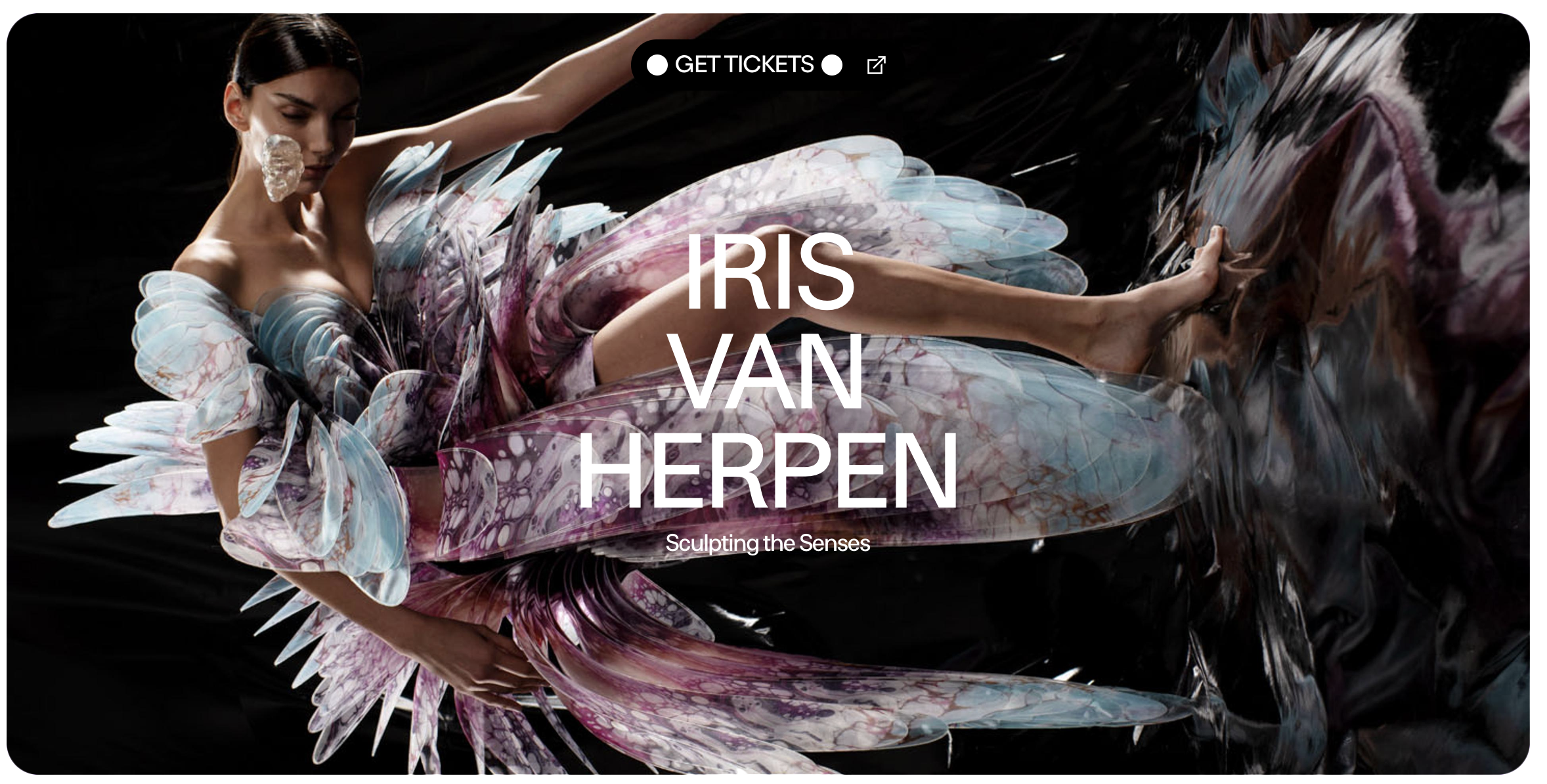
Van Herpen’s couture work is known for merging handcraft, sculptural form, and advanced material experimentation.
For nearly two decades, Dutch designer Iris van Herpen has occupied a unique place in the global fashion industry: part couturier, part materials researcher, and part futurist. Since founding her label in 2007, van Herpen has built a reputation for merging traditional haute couture craftsmanship with experimental fabrication techniques, including 3D printing, laser-cut textiles, and collaborations with architects, engineers, and scientists.
Her work challenges the traditional definition of clothing. Instead of garments built from flat patterns and standard tailoring, van Herpen often constructs pieces that appear to grow organically around the body, resembling ocean currents, skeletal structures, or atmospheric formations.
In many ways, her atelier functions less like a conventional fashion house and more like a research laboratory for the future of textiles and garment construction.
Couture as a Laboratory for Innovation
Van Herpen’s most recent official Paris couture runway presentation, the “Sympoiesis” collection, debuted at Paris Haute Couture Week on July 7, 2025.
The collection explored the ecological relationship between humans, technology, and nature. One of the most talked-about pieces featured a living bioluminescent garment, developed with biodesigner Chris Bellamy. The dress contained roughly 125 million living algae cells embedded in a nutrient gel, allowing the garment to emit a soft glow under controlled conditions.
While visually striking, the piece also represented a deeper idea: that fashion can become a testing ground for future materials, including bioengineered textiles, living fabrics, and environmentally responsive design.
The fashion industry increasingly treats couture as a form of high-level experimentation, where designers can test technologies that may eventually influence mass production.
Independence in a Conglomerate Industry
Van Herpen remains one of the few independent designers regularly presenting haute couture outside the major luxury conglomerates.
This independence has allowed her to pursue an unusually research-driven approach to design. Instead of producing large seasonal ready-to-wear collections, the brand focuses on fewer shows with deeper technical development.
The strategy reflects a broader shift within luxury fashion:
- Couture collections act as innovation incubators
- Experimental techniques often migrate into mainstream fashion later
- Designers build influence through cultural impact rather than production scale
Her work has appeared in museums around the world, including major exhibitions exploring the intersection of fashion, art, and science.
Why Costume Designers Watch Her Work
Although van Herpen designs couture rather than film wardrobes, her work has significant influence in the costume design world.
Her sculptural silhouettes, fluid structures, and biomorphic forms resemble the kinds of visual storytelling often required in fantasy or science-fiction cinema.
Costume designers working on whimsical or imaginative films—particularly those involving mythological worlds, alien environments, or dreamlike narratives—frequently look to designers like van Herpen for inspiration.
Many of her garments appear almost cinematic in nature. A single dress might evoke:
- underwater creatures
- celestial energy
- skeletal architecture
- wind or ocean currents frozen in motion
Because of this, her aesthetic fits naturally within fantasy film costume design, where clothing must help establish the emotional and visual language of an imagined world.
One can easily imagine van Herpen’s creations appearing in films similar in tone to works by directors such as Tim Burton or Guillermo del Toro, where costumes blur the line between character wardrobe and sculptural art.
In those kinds of cinematic environments, garments become part of the world-building itself—something van Herpen’s designs already accomplish on the runway.
The Textile Future
Van Herpen’s long-term influence may extend far beyond couture or film aesthetics.
The global fashion industry is under increasing pressure to address issues such as:
- textile waste
- material sustainability
- environmental impact
- overproduction
Designers experimenting with biofabrication, recycled fibers, and engineered textiles may play a key role in shaping the next generation of materials.
Van Herpen’s work demonstrates how cutting-edge science can be translated into emotionally compelling fashion design, making experimental materials desirable rather than purely technical.
A Vision of Fashion’s Next Era
As the fashion industry moves toward a future shaped by technology, sustainability, and interdisciplinary collaboration, Iris van Herpen represents a possible blueprint for what fashion can become.
Her collections exist at the intersection of:
- couture craftsmanship
- scientific experimentation
- architectural design
- cinematic storytelling
Whether appearing on museum mannequins, haute couture runways, or inspiring the next generation of film costume designers, van Herpen’s work suggests that the most powerful fashion of the future may not simply be worn—it may transform the way we imagine clothing itself.