


By World Economic News
Dateline: March 2026
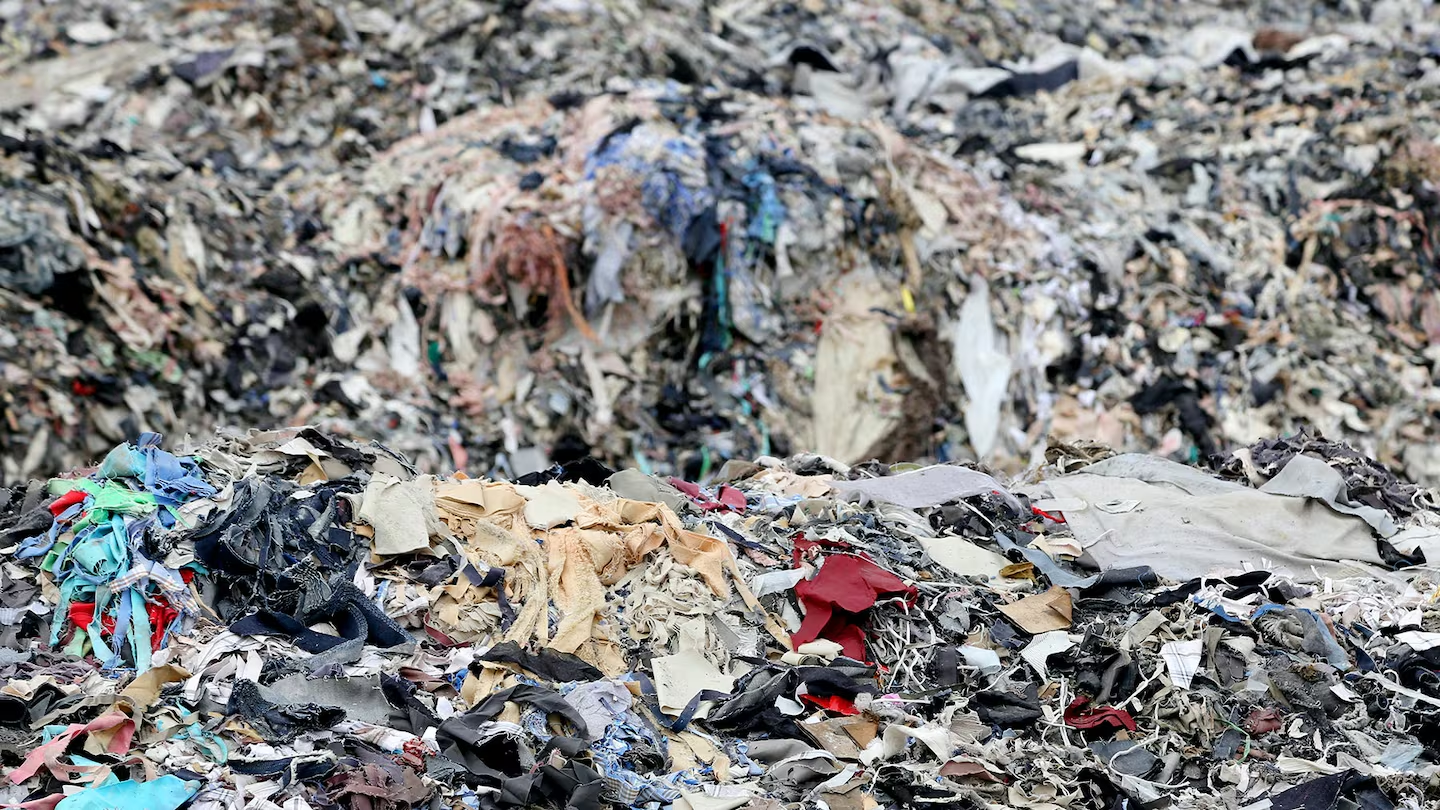
The textile story in early 2026 is no longer just about sustainability pledges. It is about regulation, cost, and industrial redesign. In February and March 2026, the sector was already absorbing the effects of Europe’s newest anti-waste framework: the revised Waste Framework Directive, which entered into force on October 16, 2025, new rules requiring separate collection of textiles across EU countries from January 1, 2025, and the next major step under the Ecodesign for Sustainable Products Regulation (ESPR)—a ban on the destruction of unsold apparel, clothing accessories, and footwear for large companies starting July 19, 2026. Together, these measures move textile waste from a reputational issue to a regulated cost center.
The immediate trigger for renewed industry attention in March was that circular-fashion initiatives were now launching into a market with real legal pressure behind them. Global Fashion Agenda and Visa’s “Recycle the Runway” program, launched in late February 2026, is explicitly framed around circular design and emerging designers rethinking waste. That matters because it is no longer operating in a voluntary vacuum; it is arriving just as Europe is forcing brands to confront what happens to unsold stock, discarded garments, and end-of-life textiles.
The data explain why Brussels acted. The European Environment Agency says EU citizens consumed an average of 19 kilograms of clothing, footwear, and household textiles per person in 2022, up from 17 kilograms in 2019. Textiles ranked among the EU’s top five household consumption categories for pressure on raw materials, greenhouse-gas emissions, water, and land use. The EEA also estimates the EU generated about 6.95 million tonnes of textile waste in 2020, or roughly 16 kilograms per person. Only about 4.4 kilograms per person were collected separately for reuse and recycling; the rest largely went into mixed household waste.
Europe’s export numbers show why lawmakers became more aggressive. The EEA reports that exports of used textiles from EU countries more than doubled between 2005 and 2023, reaching about 1.37 million tonnes in 2023, or 3.1 kilograms per person. The EU’s concern is that a system built around collection and export can too easily disguise disposal as reuse. That is why the revised Waste Framework Directive tightened definitions and sorting requirements: separately collected textiles are treated as waste unless professionally screened and sorted, making it harder to label low-value waste as reusable goods and ship the problem elsewhere.
The legal architecture is now clear. First, textile separate collection is mandatory across the EU. Second, the revised Waste Framework Directive introduces harmonized extended producer responsibility (EPR) for textiles, meaning producers will have to finance the collection, sorting, preparation for reuse, recycling, and other treatment of textile waste. Third, the ESPR adds product-level pressure by banning the destruction of unsold apparel and footwear for large companies from July 19, 2026, with medium-sized companies expected to follow in 2030. In practical terms, brands are being pushed at both ends of the chain: they must design better products up front and pay more attention to what happens after sale—or after non-sale.
For the textile industry, that means the business model is changing from linear throughput to waste-accountable production. Under EPR, waste is no longer somebody else’s problem. A producer placing garments on the EU market will increasingly bear financial responsibility for what those garments cost to sort, recycle, or dispose of later. That creates a strong incentive to use fabrics and trims that are easier to identify, separate, and recycle; to reduce fiber blends that complicate recycling; to cut overproduction; and to create products durable enough to survive reuse channels. The Commission’s broader textiles strategy is explicit: by 2030, textiles on the EU market should be more durable, repairable, recyclable, and made to a greater extent from recycled fibers.
The likely winners are the parts of the industry that can document material flows and engineer products for circularity. The likely losers are the business models that depend on high-volume, low-visibility surplus. The European Parliament’s summary of the new rules notes that textile consumption in the EU rose to 19 kilograms per person in 2022, while around 12 kilograms of clothing per person is dumped each year. That gap points directly to overproduction, low utilization, and poor recovery. Europe is effectively telling brands that dumping, destroying, or exporting the consequences of those decisions will become harder and more expensive.
For fashion design, the implications are profound. Designers are being pulled closer to waste economics. Fabric choice, construction method, dye chemistry, trim selection, and pattern efficiency are no longer only aesthetic or sourcing decisions; they affect end-of-life cost. A garment with mixed fibers, laminated components, difficult-to-remove embellishment, or complex bonded construction may look commercially attractive in the short term but become financially punitive in a stricter EPR environment. That shifts value toward mono-material strategies, modularity, repairability, clearer labeling, and cleaner bills of materials.
It also changes the conversation around textiles innovation. Circularity is not just about recycled polyester or next-generation cellulose fibers. It is also about system design: traceable inputs, sorting-friendly construction, and material choices that survive more than one life cycle. The EEA notes that in 2021 only 451,268 tonnes of textiles were reused in the EU data set it cites—about 1.7 kilograms per person—while average new textile consumption was 15.9 kilograms per person, meaning reused textiles represented only about 10% of total consumption. That is a large structural gap, and it suggests that repair, reuse, resale, and remanufacturing still have significant room to expand.
For costume design, Europe’s new waste rules matter in a different but equally important way. Costume departments have long relied on three things the broader fashion system is now revaluing: reuse, alteration, rental, and sourcing from existing stock. In film, television, opera, and theater, wardrobes are often built from a mix of newly made pieces, deadstock fabrics, vintage garments, rental inventory, and heavily altered items. As mainstream fashion is pushed away from destruction and toward reuse, costume departments may gain access to richer secondary markets—more archived stock, more sorted garments, more deadstock textiles, and more materials diverted before disposal. That could lower sourcing costs for some productions while increasing the availability of unusual or period-appropriate materials.
But there is also a warning for costume and fashion creators alike: compliance may narrow some material options. If brands simplify fabrics and trims for recyclability, future textile offerings may become less ornate, less blended, or less chemically complex. That can be positive for circularity, but it may also reduce the availability of certain high-drama surfaces, specialty coatings, or composite materials used in avant-garde fashion and screen costume. Designers who depend on those materials may need to work more closely with mills, recyclers, and specialty suppliers to secure the visual effects they want without creating non-recoverable waste streams. This is an inference based on the incentives created by the new rules rather than an explicit EU statement.
The environmental stakes are large enough that regulators are unlikely to reverse course. The EEA estimates that, per average person in the EU, textile consumption required 9 cubic meters of water, 400 square meters of land, 391 kilograms of raw materials, and generated a carbon footprint of about 270 kilograms. Those numbers help explain why textiles have become a policy target rather than a side issue. In economic terms, Europe is trying to force environmental externalities back into the price of design, production, and disposal.
What this means for the industry in 2026 is straightforward: textiles are entering an era of compliance-led design. Fashion brands will need stronger waste accounting, better inventory discipline, and closer collaboration between design, sourcing, legal, and sustainability teams. Textile manufacturers will face rising demand for materials that are easier to recycle and easier to document. Costume designers may benefit from stronger reuse ecosystems but may also face a changing palette of available materials. And for designers across both fashion and entertainment, the old separation between creativity and waste management is ending. In Europe, waste is becoming part of the brief.